
Technical article
Planetary Ball Mill Repeatability: The Jar and Ball Cause
Your parameters are not the variable. Jar wall wear and scratches rewrite particle size and purity data.
The Loop You Have Already Run Three Times
You know the pattern. You load the jar, seal it, set the program, and run. Three repetitions later the distribution has moved, the D50 you reported last month is not the D50 you get today, and one of the three runs has a tail you cannot explain. So you go back to the control panel and change something, because the panel is the only thing that looks adjustable.
Here is the repair list most labs work through, in roughly this order:
- You re-run the identical program to prove the mill is stable. The second run disagrees with the first, so you conclude the machine has drifted.
- You extend the milling time. The tail gets a little finer, the elemental reading gets a little worse, and the run-to-run spread never closes.
- You rebalance the ball-to-powder ratio. Energy goes up, the powder gets finer, and now Fe, Zr or Al is flagged in your ICP results.
- You slow the rotation down to be gentle. Wear drops slightly, comminution stalls, and you are back to grinding longer.
Every one of those moves treats the mill as a machine with one dial. None of them touches the two objects that are in contact with your powder for the entire run: the jar wall and the grinding balls. That is the gap between the experiment you designed and the experiment you actually ran.
The Variable That Is Not on the Panel
A planetary ball mill does not grind by gentle friction. The jar swings around the sun wheel while spinning about its own axis, and the media charge is repeatedly lifted and thrown against the wall. That is exactly why the technique reaches sub-micron sizes in minutes instead of hours: the impact energy per collision is high, and it is delivered thousands of times per minute. The same energy that fractures your powder also fractures the surface it lands on. Wear is not a sign of a faulty machine. It is the predictable consequence of high-energy impact, and it happens in every jar.
The useful question is therefore not whether wear occurs, but where the wear products go, where the un-ground material hides, and how much of either your sample can absorb before the numbers stop meaning anything.
Where the wear products actually go
When the ball strikes the wall, micro-asperities on both surfaces deform, crack and detach. Those fragments do not disappear. They join the powder bed. A hardened steel jar sheds iron and chromium; a zirconia jar sheds zirconium and yttrium stabiliser; an agate jar sheds silica; an alumina jar sheds aluminium. In a large production batch this contribution may sit below the detection limit. In a laboratory jar holding a few grams, the same absolute mass of debris is a completely different concentration, and it lands in the exact fraction you are trying to characterise.
Why a few grams makes it worse, not better
Consider what a small sample does to a small contamination. If a run produces a few milligrams of jar material inside a five-gram charge, you have introduced a contaminant at the hundreds-of-ppm level, and the finest fraction of that debris concentrates in the very particle size band you report as your D50. Your laser diffraction result is now partly a measurement of the jar. Your ICP result is a measurement of the jar. And because wear rate depends on the local impact history, which depends on fill level, media size and how the powder coats the wall, the amount of debris changes from run to run even when the program does not.
Defect One: Jar and Media Wear That Lands in Your Data
The mechanism
Wear severity is governed by the hardness ratio between the media, the jar wall and the powder, not by the speed setting alone. A jar that is softer than your powder is being ground along with the sample: the powder acts as an abrasive and machines the wall. A jar that is far harder than the powder survives the powder but may still shed material at the sealing surfaces and at the bottom radius where impact energy concentrates. The same logic applies to the balls. A dense, hard medium transfers more energy — which is what you want for a hard ceramic — but it also loads the wall more heavily per impact. Density, diameter and count are not independent settings; together they define the energy spectrum your jar has to survive.
This is why the contamination signature so often appears only after you optimise the process. Higher energy, larger balls or longer times all increase the number of high-load collisions. The powder gets finer on schedule. So does the jar surface.
What it does to your results
Two distortions arrive at once, and they are easy to mistake for process noise. First, the elemental baseline shifts: iron, zirconium or aluminium appears where your certificate of analysis says it should not, and the level tracks milling energy rather than the material. Second, the size distribution develops a tail that does not behave like your powder. Wear debris is typically sub-micron and irregular, so it inflates the fine end, drags the span wider, and makes the distribution look bimodal in a way that no amount of sieving or re-measurement resolves. If your powder is expensive or scarce, there is a third cost: the material that ends up smeared on the wall and trapped under the media charge is material you paid for and cannot recover.
Why process tuning does not fix it
Because the debris generation is proportional to the comminution work you are asking for. Reduce the energy and you reduce wear, but you also reduce breakage, so you compensate with time, which restores the collision count, which restores the wear. You cannot dial your way out of a materials mismatch. The only interventions that change the outcome are changing what the powder touches: the jar material, the media material and the surface condition of the wall.
Defect Two: Geometry That Traps Powder and Carries It Forward
The mechanism
Now look inside a jar that has been in service for a year. The wall carries a network of fine scratches from media impacts and from spatula contact during recovery. There is a weld seam or a shoulder radius where the cylindrical wall meets the base. There is a groove machined for the sealing ring, and on sealed or inert-atmosphere jars there is an elastomer that has been compressed, heated and exposed to solvent many times. Each of these is a dead volume. Powder is pressed into them by the same impact energy that mills it, and once it is in, the media charge cannot reach it — the balls are too large to enter a scratch a few microns deep or a groove a few millimetres wide.
The trapped fraction then does two things. It stays behind and steals mass from your yield, and it re-enters the next batch. If the previous run was a doped or coloured material, you will see it in the next run's spectra.
What it does to your results
Repeatability fails in a specific, recognisable way: the first run after cleaning looks different from the third. Yield comes back short by a percentage that varies. Trace analysis shows a carryover peak that cleaning was supposed to remove. And on inert-atmosphere jars, an ageing sealing ring adds a second failure path — a slow leak that changes the oxygen level inside the jar, or elastomer fragments that arrive in the powder as an organic contaminant you were not measuring for.
Why longer cleaning does not fix it
Cleaning removes what is on the surface. It does not remove what is inside a scratch, behind a shoulder, or under the lip of a groove, and aggressive cleaning makes the problem worse by opening new scratches. You can spend an hour per jar with solvent, brushes and ultrasonic baths and still hand the next operator a jar with a hidden reservoir of the previous sample. The defect is geometric, so the remedy has to be geometric as well.
What a Coordinated Mill–Jar–Media Design Changes
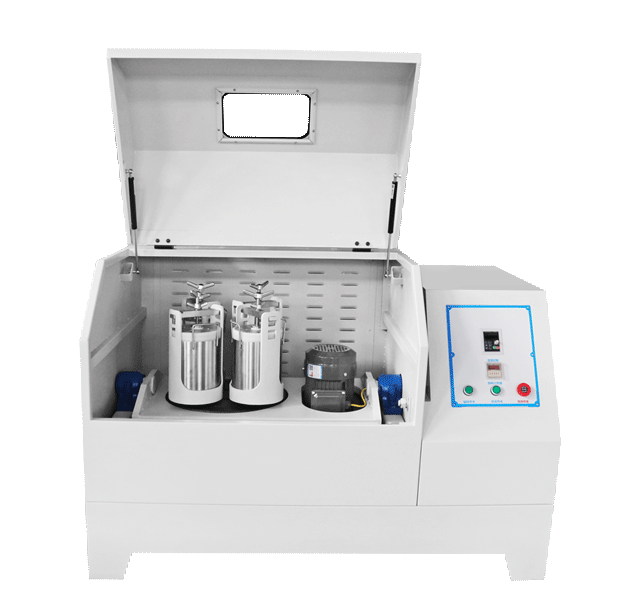
Once you accept that contamination and carryover are generated at the interface, the purchase decision changes shape. You stop choosing a mill by headline speed and start choosing a mill, a jar set and a media charge as one system — which is the design logic behind the Laboratory Full-Directional Planetary Ball Mill, where the jar motion, the jar and the grinding media are specified together instead of being assembled from three separate catalogues.
Jar material matched to the powder, not to the shelf
This answers Defect One directly. Choose the jar by asking what your powder is allowed to become: for an iron-sensitive cathode material, a steel jar is disqualified before the first run; for a hard carbide or oxide, a soft jar will be consumed; for trace-element work, the jar's own composition has to be an element you are prepared to report. The correct question is never which jar is best, but which jar's wear products are tolerable in your analysis and which jar hardness survives your powder. Material selection also determines how much of your expensive powder is left on the wall rather than recovered.
Media density and ball diameter as a single decision
Media should be chosen to deliver the energy your powder needs and no more: dense media for hard, brittle materials where fracture is the goal, lighter and smaller media where you need size reduction without a heavy wall load or excessive heat. Ball diameter is the second half of the same choice — large balls give impact, small balls give surface contact and narrower distributions. Fixing density without fixing diameter, or changing jar size without revisiting both, is exactly how a parameter set that worked in a 50 ml jar stops working after a scale-up. If you calibrate media and jar together, the transfer to a larger jar becomes a calculation rather than a guess.
Interior finish and cleanable geometry
This is the direct answer to Defect Two. A polished interior with radiused transitions instead of sharp internal corners, no unnecessary seams, and a sealing groove designed to be emptied rather than merely wiped, removes the places where powder hides. When the geometry is cleanable, cleaning time falls and the residual from the previous batch falls with it — which is what your third repetition actually needs. A smooth, hard wall also reduces the nucleation sites where wear debris begins.
Sealing components treated as part of the wetted path
If you mill under inert gas or in solvent, the sealing ring is a process component, not a consumable afterthought. The elastomer must be compatible with your solvent, rated for the temperature the jar reaches during milling, and inspected on a schedule so that ageing is replaced before it becomes a leak or a source of fragments. Treating the seal as part of the powder-contact system is what keeps an oxygen-sensitive run from drifting quietly between batches.
What You Actually Gain
When the jar, the media and the machine are selected together, the failures you have been attributing to your technique start to resolve in ways you can defend in a report:
- Batch-to-batch repeatability that survives the third run, because the wall stops changing and the dead volumes stop storing the previous sample.
- Data you can publish, with an elemental baseline you can explain and a distribution tail that reflects your powder rather than your container.
- Expensive material retained in the yield instead of distributed across a scratch pattern.
- A defensible scale-up path, because the jar and media variables were chosen deliberately and can be re-specified when the batch grows.
If you are currently stuck in the loop, the fastest way out is to describe the problem in interface terms rather than panel terms. Tell us what the powder is, what hardness it presents, which elements you cannot tolerate in the certificate, how many grams you mill per batch, whether you work under inert gas, and what jar and media you are using now. From that, a jar material, a media density and diameter, an interior finish and a sealing specification can be selected as a set — and you will finally know whether the last three inconsistent runs were a process problem or a container problem.