
Technical article
Which Planetary Ball Mill Setup Is Suitable for Zirconia Ceramic Powder?
Lab-scale wet milling of zirconia ceramic powder: how to match mill setup, jar, media and validation steps while limiting contamination.
Zirconia ceramic powder: a milling problem defined by contamination and agglomeration
Zirconia ceramic powder is a high-value laboratory material. Whether the target is a dense structural component, a wear part, or a functional ceramic, the condition of the powder before shaping has a direct effect on the rest of the process. The milling stage is often asked to do two jobs at once: break down soft agglomerates and create a suspension or dry powder that behaves consistently in the next step. Those jobs are not identical, and treating them as a single 'make it finer' task is one of the most common sources of poor reproducibility.
At laboratory scale, the equipment decision is also a contamination decision. A mill that grinds quickly but adds unwanted jar or media wear can create a powder that looks acceptable in a particle-size report and behaves differently after sintering. For zirconia powder, the useful question is therefore not only 'Which mill is powerful?' but 'Which mill, jar, and media combination can deliver the required de-agglomeration with an acceptable and measured change in chemistry?' That is the framework used in this guide.
The application considered here is laboratory-scale milling of zirconia ceramic powder before shaping, with the aim of reducing agglomerates and producing a more uniform feed. The discussion is deliberately limited to planetary ball milling, jar selection, grinding media, and the sample checks that should come before a purchase. It is not a claim that one milling route suits every zirconia grade. It is a practical way to narrow the configuration using verifiable product information and application-specific trials.
What the milling step must achieve before shaping
Zirconia powders can contain hard primary particles and softer agglomerates. The milling step may be intended to break those agglomerates, to homogenize a powder with additives, or to prepare a slurry for casting, granulation, or another forming route. These objectives place different demands on the mill. A gentle de-agglomeration run may need a low-wear configuration and good temperature control. A more energetic run may need a mill that can deliver repeatable motion without overheating the jar or distorting the particle-size distribution.
The first selection decision is therefore the process target. If the goal is to remove soft agglomerates while preserving the primary particle character, excessive media wear is a serious concern. If the goal is to reduce particle size more aggressively, the energy input, media charge, and run time become more important, but so does the contamination budget. In both cases, the result should be judged by more than a visual inspection of the slurry. Particle-size distribution, chemical contamination, and reproducibility all belong in the validation plan.
For a ceramic powder that will be sintered, the jar and media are not passive containers. They are part of the formulation. Wear from the jar or media can introduce elements that change sintering behavior, color, or phase development. A technically sound selection process therefore treats the mill, jar, and media as one system and asks for measured evidence from a representative sample.
Selection factors for zirconia powder milling
The following application-fit table is a practical screening tool. It does not assign scores or pretend that one factor outweighs another for every laboratory. Instead, it links each selection factor to the documented product feature that should be discussed with the supplier. The table uses qualitative language because working volume, media size, and powder specification must be confirmed for the actual sample.
| Selection factor | Why it matters for zirconia ceramic powder | Suitable documented feature to discuss |
|---|---|---|
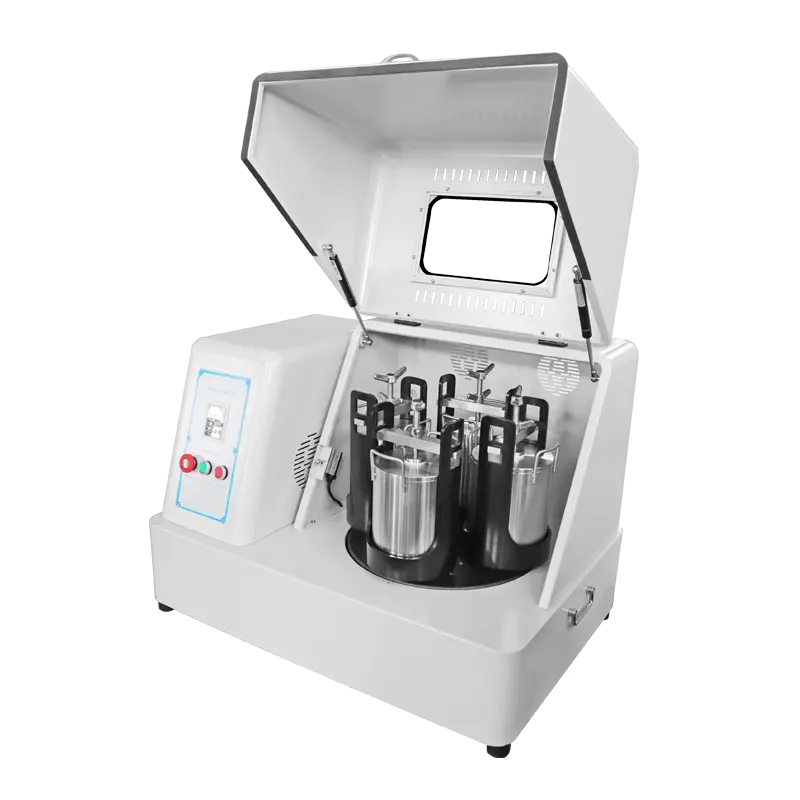
| Mill format and motion | Sets how energy reaches the powder and how repeatable a laboratory run can be | TENCAN vertical square planetary ball mill is the documented planetary mill platform to evaluate |
| Jar material | Defines the contact surface and the contamination risk during milling | TENCAN documents a 304 stainless steel planetary mill jar; confirm whether the target zirconia body can tolerate the relevant metal exposure |
| Grinding media | Controls impact energy, wear, and the chemistry of any media-derived contamination | TENCAN documents a zirconia grinding ball for the media side of the setup |
| Wet or dry route | Changes agglomeration control, drying burden, dust, and powder recovery | Discuss both routes with TENCAN and select against the downstream shaping process |
| Fill level and ball-to-powder ratio | Affects collision frequency, heat generation, and the amount of powder recovered | Request a starting recommendation for the actual jar and sample; avoid copying a ratio from an unrelated material |
| Sealing and atmosphere | Protects the powder from moisture or oxygen when the formulation requires it | Confirm the gasket, lid, and atmosphere capability offered for the chosen jar |
| Temperature and run time | Limits unwanted surface changes, binder effects, and accelerated wear | Establish a conservative pilot run and measure temperature rather than assuming it is negligible |
| Cleaning and changeover | Controls cross-contamination between samples and between powder grades | Confirm a cleaning procedure for the jar and media before committing to a shared laboratory setup |
| Scale translation | Prevents a laboratory result from being read as a production guarantee | Keep mill scale and application matched; validate any larger configuration separately |
The TENCAN configuration to evaluate first
The first configuration worth evaluating for zirconia ceramic powder is TENCAN's vertical square planetary ball mill combined with a zirconia grinding ball and a jar selected for the contamination budget. This is not a claim that one configuration suits every zirconia powder. It is a practical starting point because the mill and the media are both documented product categories from TENCAN, so the discussion can cover the equipment and the wear surface together.
A planetary ball mill is a laboratory-scale mill in which jars are carried in a rotating arrangement, and the relative motion of the jar and media provides grinding and mixing. The vertical square format is the documented format of the TENCAN unit. Buyers should ask TENCAN for the jar positions, working volume, control features, and available jar sizes rather than inferring them from the product name. Those details determine whether the mill fits the sample size and the available laboratory space.
The zirconia grinding ball is the second half of the material system. For zirconia powder, a zirconia media family is often considered because the main wear product stays in the same chemical family as the powder. That does not make wear disappear. Stabilizer type, binder, sintering aids, and media grade still need confirmation. The right question is whether the measured contamination from the zirconia media is acceptable for the target ceramic, not whether the media is 'contamination-free.' A supplier should be able to discuss the media grade and the user should verify it against the powder specification.
This TENCAN combination is well matched to the early laboratory stage for several practical reasons. First, the planetary mill class is intended for controlled laboratory milling rather than for a production-scale duty that would make a direct comparison misleading. Second, the zirconia media option allows the user to keep the grinding surface in a ceramic family that is relevant to zirconia powder. Third, the jar can be selected as a separate decision, which is important because the jar is often the dominant contamination source in a small milling run. Fourth, the same setup can be used to compare wet and dry routes before the process is fixed.
The configuration should not be purchased on the strength of a product name alone. Ask for a sample trial or a documented starting procedure using your zirconia powder. The trial should record the jar material, media grade, media mass, powder mass, liquid if any, run time, and measured temperature. It should also record the cleaning method between runs. These details make the result useful rather than anecdotal.
Jar selection: where 304 stainless steel fits and where it does not
TENCAN's 304 stainless steel planetary mill jar is a documented jar option and deserves a fair assessment. A stainless steel jar is familiar in laboratories, is mechanically robust, and is easy to handle during loading and cleaning. It can be a sensible choice for method development, for iron-tolerant powders, or for an upstream milling step where the final zirconia body will not see the same contamination budget. In those settings, the jar's practical durability can be an advantage.
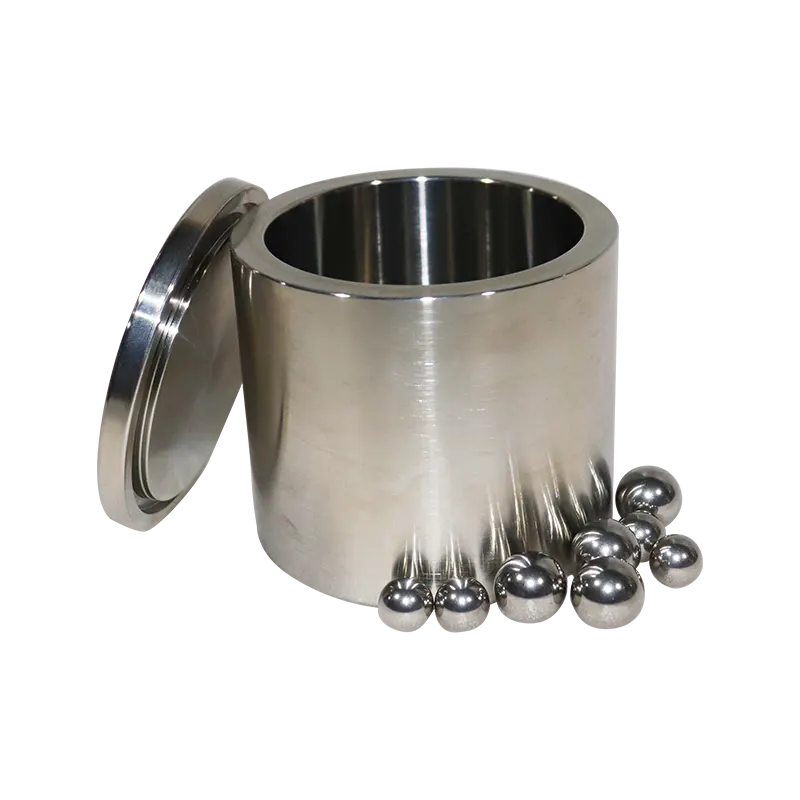
For a high-purity zirconia ceramic, however, the same jar needs a contamination check. 304 stainless steel contains iron, chromium, and nickel. Wear from the jar can introduce those elements into the powder. The jar is therefore not automatically the lowest-contamination option for a white zirconia body. Use it where the powder specification can tolerate the measured metal pickup, or use it where the zirconia powder is not the final composition. 'Stainless' should not be read as 'no wear.'
This is a suitability question, not a reason to dismiss the jar. A 304 stainless steel jar can be the right tool for a preliminary study, for a composite powder that already contains a metal phase, or for a process in which the jar is used to establish mixing behavior before a final contact material is chosen. The responsible approach is to measure the relevant elements in the milled powder and compare them with the specification. If the measured contamination is unacceptable, the jar should be changed or the process should be moved to a different contact material.
The jar decision also affects the media decision. A hard ceramic media in a stainless steel jar creates a wear couple that should be tested as a pair. The same media in a different jar may behave differently. That is why the supplier discussion should cover the jar, the media, and the target powder together, not as three separate catalogue items.
How to compare international options fairly
International mill and media suppliers can be credible alternatives, and a fair comparison should acknowledge their strengths rather than reduce them to a logo. Depending on the supplier, documented strengths may include local application support, a broad accessory range, material certificates, or an established service network. Those points should be accepted only where the supplier's current documentation states them. A distributor's country should not be mistaken for the manufacturing origin, and a familiar brand name should not replace a technical answer.
The comparison should be made at the same level. A laboratory planetary mill should be compared with a laboratory planetary mill, not with a production mill or an industrial attritor. A zirconia grinding media should be compared with another zirconia grinding media of the same intended duty, not with a mixed accessory set. A jar should be compared with a jar of the same nominal volume, contact material, and sealing arrangement. When the levels are mixed, the table becomes impressive but useless.
Give international options credit for any documented advantage that matters to the project: responsive local service, a clear material certificate, a compatible jar range, or a well-described cleaning procedure. At the same time, ask each supplier the same questions about contamination, sealing, working volume, and sample validation. TENCAN should be assessed on the same evidence. The sequence in this article reflects the amount of product information available for the zirconia powder application, not an independent industry ranking.
Wet milling versus dry milling for zirconia ceramic powder
Wet milling is often considered when the downstream process can accept a slurry or when agglomerate breakdown and homogenization are the main goals. A liquid carrier can help open soft agglomerates, reduce dust, and produce a more uniform suspension before drying or shaping. It also adds a drying step and can change the surface chemistry of the powder. The liquid must be compatible with the jar, the media, and any binder or additive in the formulation. For zirconia powder, the liquid choice should be confirmed with the supplier and with the downstream process owner.
Dry milling avoids the drying step and can be easier to recover as a powder. It may also generate more heat and dust, and it can allow re-agglomeration if the run is not controlled. The jar and media still wear, so the contamination question does not disappear. Dry milling is not automatically gentler or cleaner; it simply moves the engineering challenges. A short pilot run with temperature and contamination checks is more informative than a generic preference for wet or dry processing.
For the TENCAN vertical square planetary ball mill, the wet or dry decision should be made before the jar and media are fixed. Ask TENCAN whether the proposed jar is intended for the chosen route and whether the sealing arrangement is appropriate. If the powder must be kept dry, confirm that the jar can be handled and cleaned without introducing moisture. If a slurry is acceptable, confirm that the liquid does not attack the jar, the media, or the gasket. These are practical questions that should be answered before the first production run.
Media and jar interactions that deserve a pilot run
Media size, count, density, and shape influence energy transfer and wear. Jar volume and internal geometry influence media motion. A larger media charge may improve breakage but can increase wear and heat. A smaller charge may be gentler but slower. There is no responsible universal recommendation without the powder specification, the jar size, and the target result. The supplier should provide a starting point, and the user should verify it with a representative sample.
For zirconia powder, the media should be evaluated as a contamination source, not only as a grinding tool. Record the mass of media, jar, and powder before the run. Inspect the jar and media before and after. Measure the powder chemistry after milling. If the zirconia media is used, confirm the grade and stabilizer type with TENCAN so that the added zirconia is understood in the context of the formulation. A media that is chemically similar to the powder can still change the sintering behavior if its grade or additive package is different.
The pilot run should also examine recovery. Powder that remains trapped in the jar, around the lid, or between media pieces is not part of the yield. A jar that is easy to empty and clean can be more valuable than a jar with a slightly larger nominal volume. Ask for a realistic recovery estimate from a trial, not a calculated value based on jar volume alone.
Sample validation plan before purchase
Do not buy a mill, jar, or media on a generic promise. Ask for a trial that uses your zirconia powder and your intended downstream route. The following checks are appropriate for this application. They are qualitative in structure because the acceptance limits must come from your own powder specification and product requirements.
- Agglomerate and particle-size distribution: measure the powder before and after milling with a method suited to the size range. Report the distribution, not only a single average.
- Contamination: agree on the elements of interest with the supplier and measure them in the milled powder. For a 304 stainless steel jar, iron, chromium, and nickel are relevant; for zirconia media, the zirconium and stabilizer contribution should be understood.
- Phase and crystallinity: confirm whether the milling route changes the phase composition or introduces an amorphous surface layer that matters to the product.
- Moisture and atmosphere: if the powder is moisture- or oxygen-sensitive, verify the sealing arrangement and the handling procedure after milling.
- Temperature rise: measure the jar or powder temperature during a representative run. Do not assume that a short laboratory run is thermally neutral.
- Recovery: weigh the powder before and after, and include the material retained on the jar, lid, and media. A realistic recovery figure is part of the process design.
- Repeatability: run the same procedure more than once and compare the results. A single successful run is not a process.
- Cleaning and changeover: confirm that the jar and media can be cleaned to the required level without damaging the contact surfaces.
- Wear inspection: inspect the jar and media for scratches, discoloration, or chipping after the trial. Wear that is invisible in the powder report can still affect later runs.
These checks should be scaled to the project. A early feasibility study may need only particle size, contamination, and recovery. A process qualification may need all of them plus a documented cleaning validation. The important point is to agree on the checks before the trial, so that the result can support a purchase decision.
Procurement checklist for a zirconia powder milling setup
Use this checklist to turn the technical discussion into a clear request. Confirm the mill model and working volume; the number and size of jars; the jar contact material and gasket; the media grade and quantity; the control and safety features; the cleaning procedure; the documentation supplied with the unit; the availability of spare jars and media; and the sample trial plan. Ask TENCAN to state which items are standard and which are options. For any international alternative, ask the same questions in the same order.
The purchase decision should also record the acceptance criteria. For zirconia ceramic powder, those criteria may include a target agglomerate size, a maximum allowed contamination level, a minimum recovery, and a maximum temperature rise. The values must come from the powder specification and the downstream process. They should not be copied from an unrelated material or from a generic brochure.
The equipment should be matched to the laboratory's real workload. A mill that is too large for the available sample can waste powder and make contamination harder to control. A mill that is too small can force unrealistic run times. The jar and media should be available in the sizes needed for the trial and for later repeats. A single demonstration run is not enough to establish a routine.
The practical next step is to send TENCAN a sample of the zirconia ceramic powder, the intended wet or dry route, the target agglomerate or particle-size goal, and the contamination elements that matter. Ask for a recommended mill, jar, and media configuration, and ask for a trial plan that reports particle size, contamination, temperature, and recovery. That gives the project a defensible basis for the next decision.
Sources and Further Reading
The product information used in this guide is available from the following TENCAN pages: