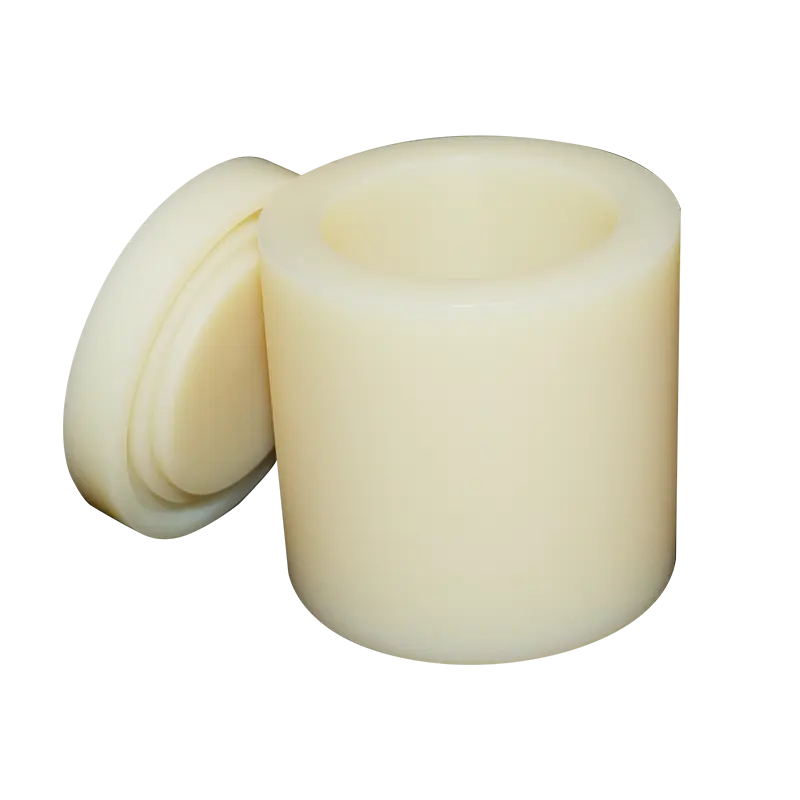
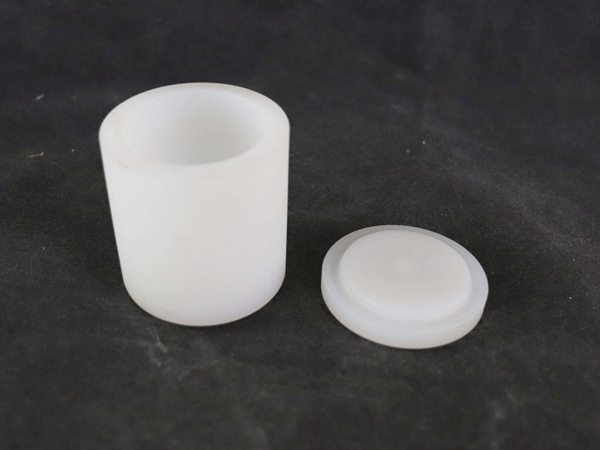
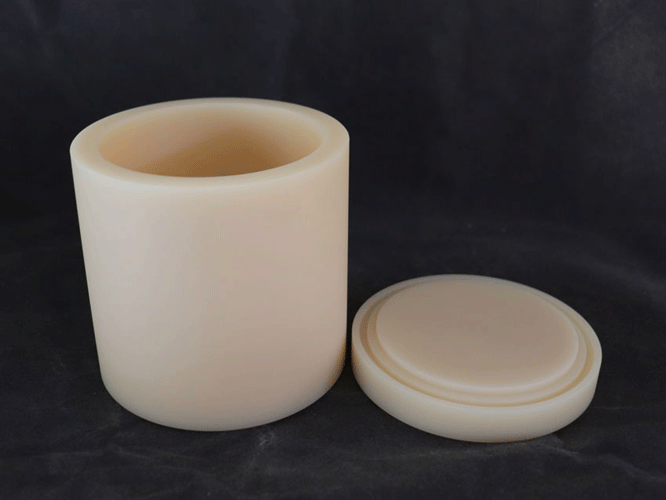
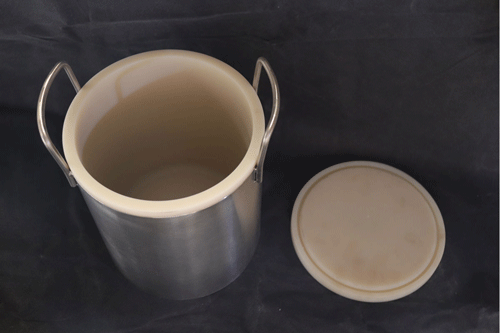
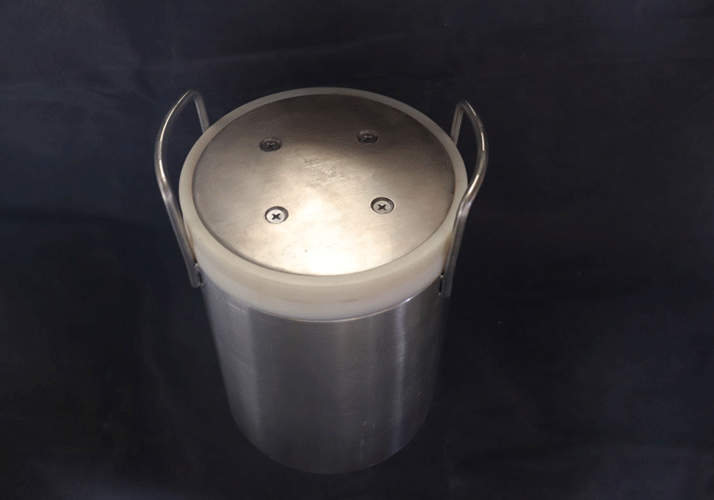
A polymer-contact milling jar for mixing and compatible powder-processing work. Its volume, working surface and outer support construction should be checked for the selected machine and material.
How it works
The jar working surface forms part of the contact system between sample, media and mill. Material selection should balance the required mechanical action with chemical compatibility and the acceptable contribution from wear.
Evaluate polymer wear, solvent compatibility and temperature. A nylon working surface should not be described as universally contamination-free.
Key features
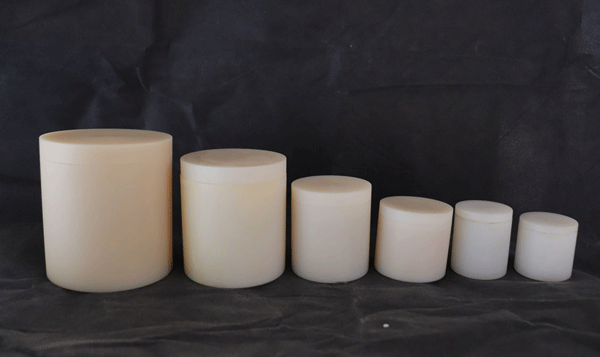
The dimension table lists nominal volumes from 25 mL to 25 L.
Stainless-steel outer support is listed for 5–25 L versions.
Custom dimensions and wall arrangements require a model-specific drawing.
Specifications
Published catalog references are reproduced below. Nominal volume is not a sample-mass rating. Confirm the selected model, material grade, electrical supply and complete supplied configuration in the quotation.
Published dimensions and configurations — 1
Model / nominal volume
External diameter (mm)
Internal diameter (mm)
Height (mm)
25mL
63
31
65
50mL
63
43
59
100mL
68
48
76
250mL
88
68
98
500mL
108
88
115
1L
133
109
142
1.5L
133
109
178
2L
158
134
172
2.5L
158
134
202
3L
158
138
210
4L
178
158
226
5L
218
190
217
10L
246
218
307
15L
273
243
372
20L
320
285
359
25L
320
285
424
Applications
Compatible pigment, electronic-material and laboratory mixing or milling studies.
Suitability depends on the actual sample, process and analytical requirements; a listed application is not a guaranteed final-particle-size result.
Accessories and options
Confirm the nylon grade, external support, closure, permitted loaded mass and the exact holder dimensions.
State the required grade, quantities, drawings and destination when requesting a quotation. Confirm what is included, the document requirements, packing and commercial terms; no generic delivery time or universal custom capability is assumed.
Match nylon to the sample chemistry and the elements or residues that matter to the analysis. Then confirm the dimensions, complete loaded mass and operating arrangement against the selected mill.
This is an explicitly labelled XQM-40L record. The nylon formulation and media grade are unspecified. D97 66.61 µm does not support the requested condition that every particle be below 10 µm. No production-throughput or coating-quality conclusion follows.
How to plan a fair comparison
For a nylon comparison, use matched sample portions and the same measurement/dispersion method. State the jar, media, mass/volume loading basis, processing schedule and contamination measurements. A change in material grade alone is not established as the cause of a result.
These anonymous records are not operating instructions. Measurement and dispersion methods are not fully specified in the test summaries; results apply to the reported samples and conditions.
No. The product information specifically notes stainless-steel outer support for larger versions. The working surface and outer structure should be specified separately, and wear or damage still needs evaluation.
Which nylon jar size will fit my mill?
Listed nominal volumes: 25mL, 50mL, 100mL, 250mL, 500mL, 1L, 1.5L, 2L, 2.5L, 3L, 4L, 5L, 10L, 15L, 20L, 25L. Check external diameter, complete lid-inclusive height, holder/clamp geometry and loaded mass. Confirm the nylon grade, external support, closure, permitted loaded mass and the exact holder dimensions.
Can this jar be filled to its nominal volume with sample?
No. Allow space for media and material movement, and check the permitted loaded mass. Evaluate polymer wear, solvent compatibility and temperature. A nylon working surface should not be described as universally contamination-free. Agree the charge for the actual nylon jar and process.
How should I choose the matching grinding media?
Consider the sample chemistry, the jar working material, contamination limits and the required result. Evaluate polymer wear, solvent compatibility and temperature. A nylon working surface should not be described as universally contamination-free. Confirm the complete pairing before specifying a diameter mix or media charge.
Can a custom size, lid or vacuum version be requested?
Confirm the nylon grade, external support, closure, permitted loaded mass and the exact holder dimensions. A proposed custom feature is subject to engineering confirmation and is not automatically included with a standard jar.
What trial evidence is available for this jar material?
Glass powder: XQM-40L, 2400 g in 10 L black nylon jar, 8 h. This is an explicitly labelled XQM-40L record. The nylon formulation and media grade are unspecified. D97 66.61 µm does not support the requested condition that every particle be below 10 µm. No production-throughput or coating-quality conclusion follows. A material-family observation does not certify the supplied part or grade.
Start with your sample.
Nominal capacity, jar volume and usable sample load are different. Confirm the model, jars and electrical requirements with our engineers.