
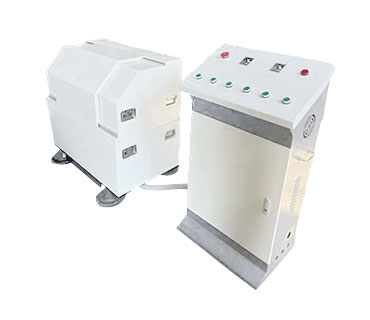
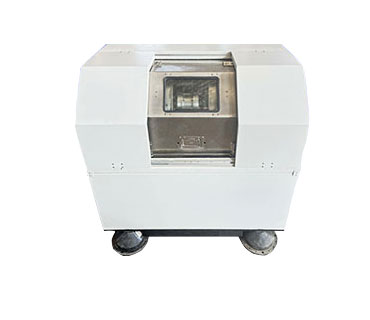
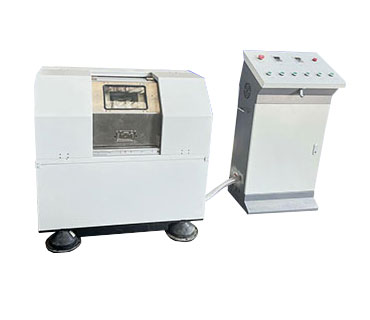
LXYM series
Continuous planetary ball mill
A continuous planetary milling range for feed trials, process development and production configurations.
Overview
A continuous planetary milling range for feed trials, process development and production configurations. The listed LXYM models use multiple chambers; chamber volume is not a published throughput rating.
How it works
The chamber assemblies revolve and rotate while material is processed through the configured feeding and discharge arrangement. Residence time and feed behaviour need to be established for the actual material.
Key features
- The chart lists configurations with two to six chambers.
- Combined chamber volumes are shown as explicit volume calculations, from 0.25 × 2 L upward.
- Revolution and rotation drives are listed separately; some larger entries specify gear transmission rather than a separate rotation-power value.
Specifications
Published catalog references are reproduced below. Nominal volume is not a sample-mass rating. Confirm the selected model, material grade, electrical supply and complete supplied configuration in the quotation.
| Reference | Model | Chambers | Combined chamber volume (L) | Revolution speed (rpm) | Revolution drive power (kW) |
|---|---|---|---|---|---|
| Continuous unit 1 | LXYM-2T-1 | 2 | 0.25*2=0.5 | 300~500 | 1.1 |
| Continuous unit 2 | LXYM-4T-2 | 4 | 0.25*4=1 | 300~500 | 1.5 |
| Continuous unit 3 | LXYM-3T-3 | 3 | 0.5*3=1.5 | 300~500 | 2.2 |
| Continuous unit 4 | LXYM-4T-4 | 4 | 0.5*4=2 | 300~500 | 2.2 |
| Continuous unit 5 | LXYM-6T-5 | 6 | 0.5*6=3 | 300~500 | 3 |
| Continuous unit 6 | LXYM-4T-6 | 4 | 2*4=8 | 300~500 | 4 |
| Continuous unit 7 | LXYM-6T-7 | 6 | 3.0*6=18 | 300~500 | 18.5 |
| Continuous unit 8 | LXYM-4T-8 | 4 | 50*4=200 | 300~500 | 75 |
| Reference | Rotation speed (rpm) | Rotation drive power (kW) | Listed process scale |
|---|---|---|---|
| Continuous unit 1 | 800-3000 | 0.75 | Continuous process characterization / feed trials |
| Continuous unit 2 | 800-3000 | 1.1 | Continuous milling / feed optimization |
| Continuous unit 3 | 800-3000 | 1.5 | Continuous milling / feed optimization |
| Continuous unit 4 | 800-3000 | 1.5 | Continuous milling / feed optimization |
| Continuous unit 5 | 800-3000 | 2.2 | Pilot continuous milling / feeding |
| Continuous unit 6 | 800-3000 | 4 | Pilot continuous milling / feeding |
| Continuous unit 7 | 800-3000 | Gear drive | Continuous production / feeding |
| Continuous unit 8 | 800-3000 | Gear drive | Production continuous milling / feeding |
Applications
Continuous feed studies, process optimization, mechanochemical research and configured production powder processing.
Suitability depends on the actual sample, process and analytical requirements; a listed application is not a guaranteed final-particle-size result.
Accessories and options
Discuss feed/discharge hardware, process-contact materials, media, controls and utilities as an integrated proposal. A batch mill’s jar accessories cannot be assumed to fit a continuous system.
- Jar and media: confirm material, volume, holder fit and the complete working load.
- Vacuum or gas requirements: specify the complete jar, lid and seal arrangement; no pressure rating is assumed.
- Utilities and supply scope: state voltage, frequency, phase, destination and required documents; confirm included versus optional items.
Compare milling jars · Compare grinding media · Low temperature planetary grinding machines · Ultrasonic planetary ball mills
Selection guidance
Specify feed form, intended feed rate, required product distribution and the collection arrangement. Ask how residence time, media retention and discharge will be assessed; no universal kg/h value is inferred from chamber volume.
Work through the selection guide · Request a configuration quotation
Trials and comparisons
No identifiable trial of this exact product/configuration was found in the available planetary-milling test summaries. A result from a different mill, jar grade or assistance system is not attributed to this product.
A comparison to request
Compare feed rate and residence conditions while keeping material and analytical methods consistent. Batch XQM workbook results do not verify continuous LXYM performance.
Discuss a sample evaluationProduct FAQs
Can chamber volume be converted directly into kg/h?
No. Throughput also depends on feed behaviour, residence time, the required result and the configured collection system. The published chart provides chamber volumes and drive references, not a universal mass-flow guarantee.
How should I select the LXYM series configuration?
Specify feed form, intended feed rate, required product distribution and the collection arrangement. Ask how residence time, media retention and discharge will be assessed; no universal kg/h value is inferred from chamber volume. The chart lists configurations with two to six chambers. Nominal mill capacity is not the usable sample mass; account for media and working space.
Which jars and grinding media should I request for this mill?
LXYM uses a continuous chamber arrangement. Confirm its chamber contact materials and feed/collection layout instead of selecting from a batch-jar chart. Choose the jar working material and media around sample chemistry and contamination limits; confirm the complete loaded mass.
Are cooling and ultrasonic equipment included?
Discuss feed/discharge hardware, process-contact materials, media, controls and utilities as an integrated proposal. A batch mill’s jar accessories cannot be assumed to fit a continuous system. Optional equipment is included only when it is explicitly listed in the agreed configuration and quotation.
What trial evidence is available for this mill?
No matching measured trial is identified for Continuous planetary ball mill in the available summaries. Compare feed rate and residence conditions while keeping material and analytical methods consistent. Batch XQM workbook results do not verify continuous LXYM performance. A free sample-grinding application can be reviewed by TENCAN engineers.
What should I include in an export quotation request?
Specify LXYM series, sample and jar requirements, destination, mains voltage, frequency and phase. Specify feed form, intended feed rate, required product distribution and the collection arrangement. Ask how residence time, media retention and discharge will be assessed; no universal kg/h value is inferred from chamber volume. Confirm included accessories, packing, required documents, commercial terms and lead time in the quotation.
Start with your sample.
Nominal capacity, jar volume and usable sample load are different. Confirm the model, jars and electrical requirements with our engineers.
Choosing a Planetary MillWILL IT WORK
FOR YOUR MATERIAL?
Plan a sample evaluation with our engineers.
Request free sample grinding