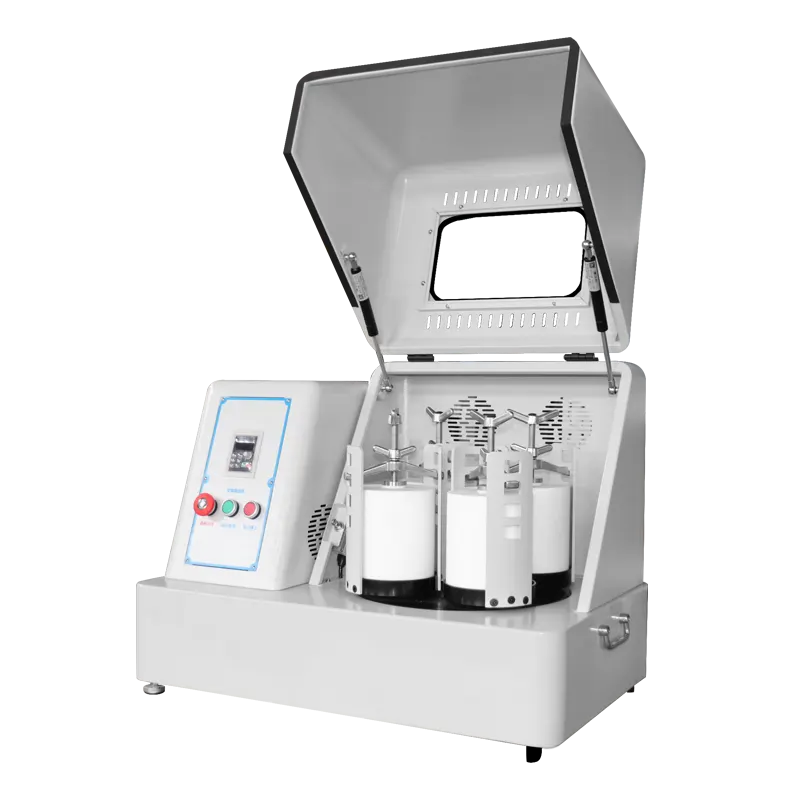
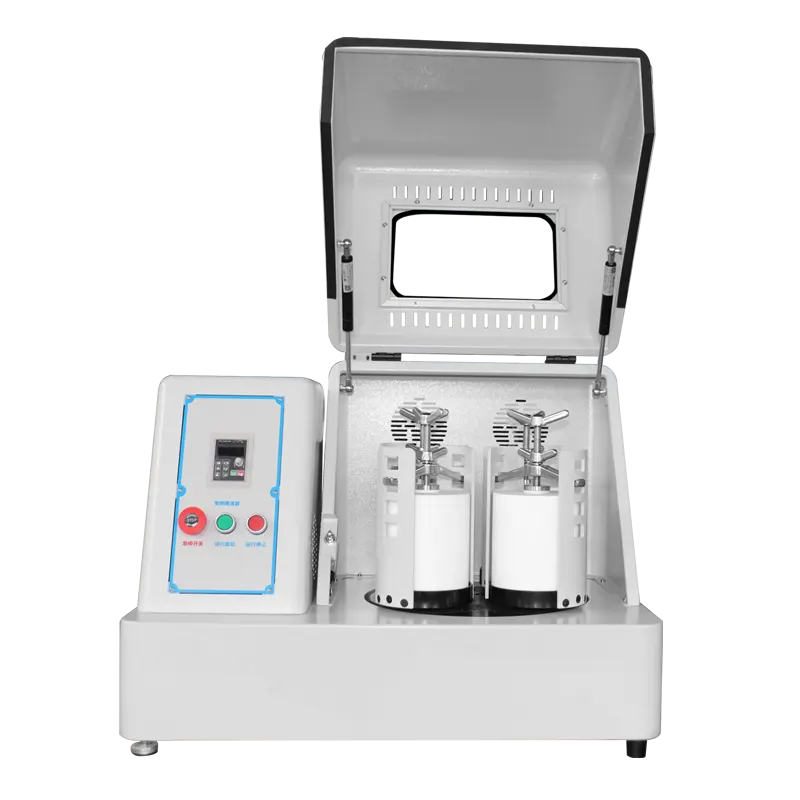
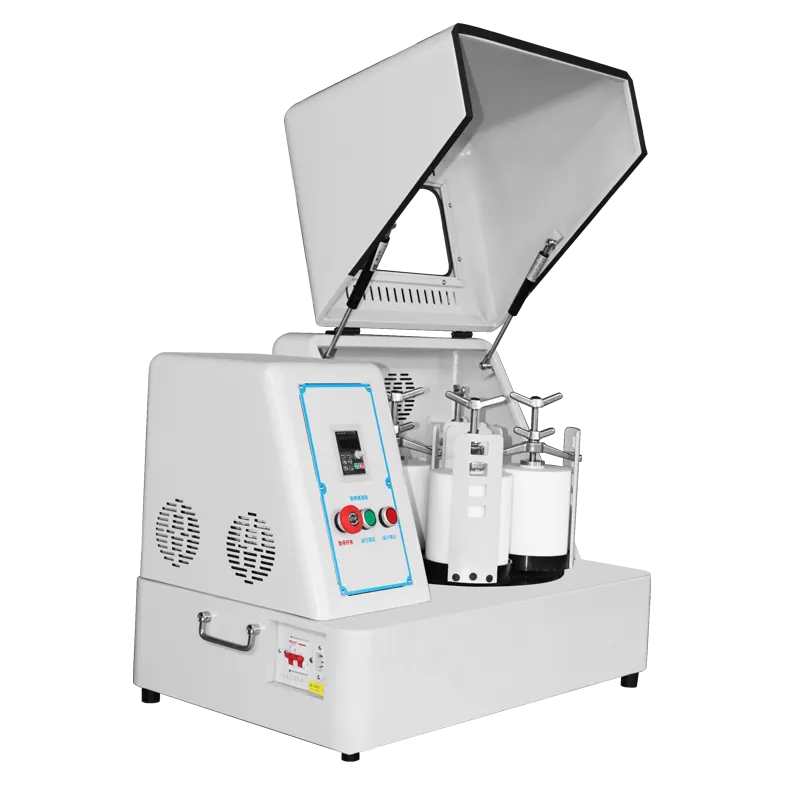
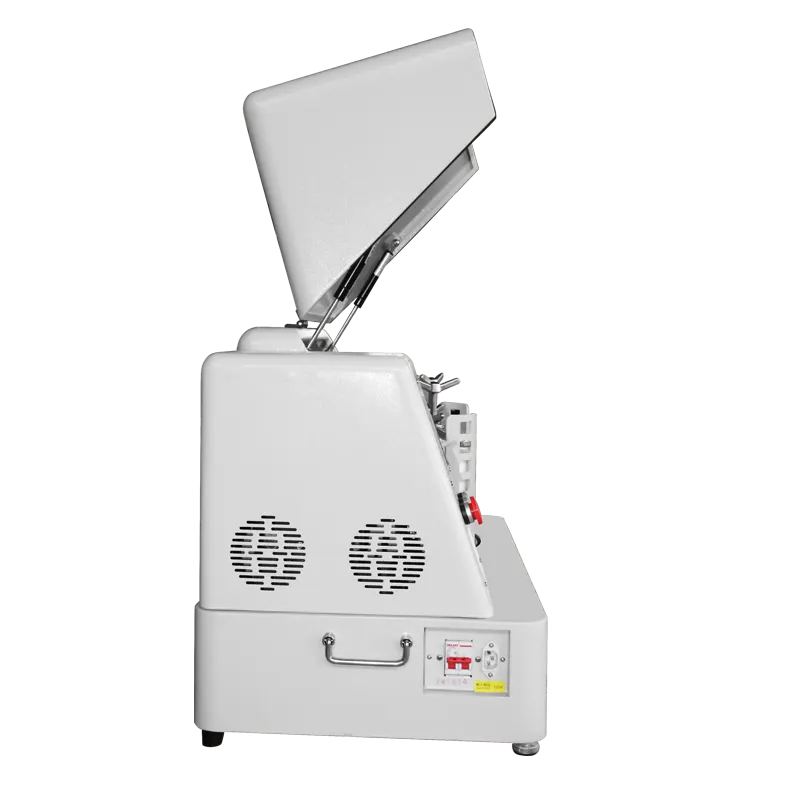
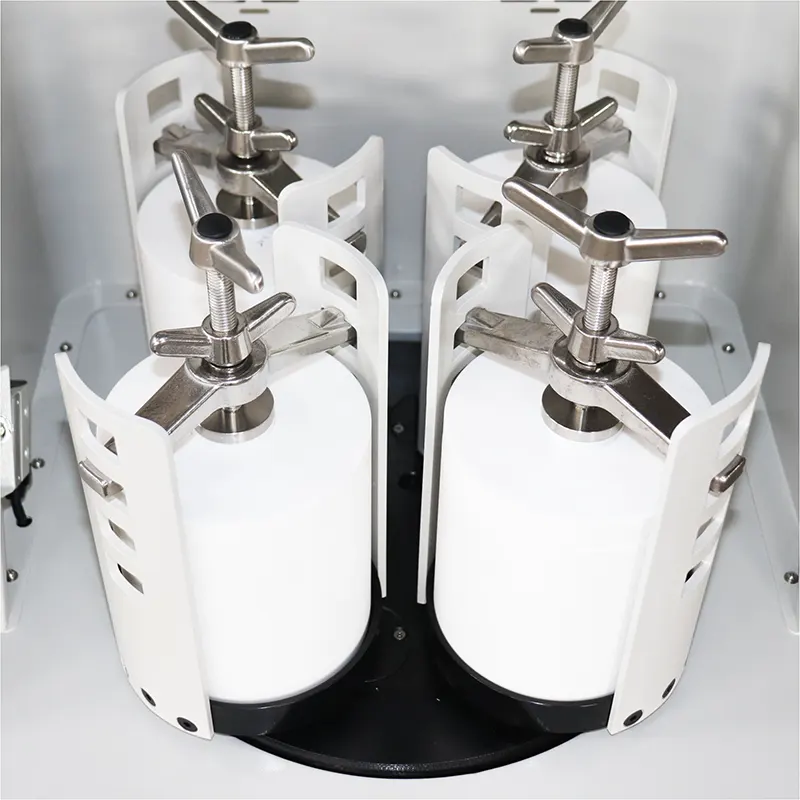
The Laboratory planetary grinder is a TENCAN laboratory machine for grinding, mixing and sample preparation. The English catalog publishes nine XQM-A configurations from 0.4 L to 16 L, each with four jar positions.
How it works
The planetary disk revolves while the grinding jars rotate. Impact and friction between the media and sample provide the grinding and mixing action. Select the actual jar, media and process conditions for the material.
Key features
Four jar positions with model-dependent jar compatibility.
Variable-frequency speed control and timed forward/reverse operation.
Published configuration tables identify supply, power, speeds, mass and equipment dimensions.
Specifications
Published English catalog specifications. Nominal jar capacity is not a sample-mass rating. Confirm the supplied configuration in the quotation.
Basic configuration parameters
Model
Specification
Compatible Grinding Jar Specification
Quantity
Compatible Vacuum Grinding Jar Specification
Equipment Weight (kg)
Equipment Dimensions (mm)
XQM-0.4A
0.4L
25-100mL
4 pcs.
Compatible with 50mL Vacuum Grinding Jars
29
500×300×340
XQM-1A
1L
50-500mL
4 pcs.
Compatible with 50-250mL Vacuum Grinding Jars
85
760×470×600
XQM-2A
2L
50-500mL
4 pcs.
Compatible with 50-250mL Vacuum Grinding Jars
85
760×470×600
XQM-4A
4L
250-1000mL
4 pcs.
Compatible with 50-500mL Vacuum Grinding Jars
85
760×470×600
XQM-6A
6L
1-1.5L
4 pcs.
Compatible with 50-1000mL Vacuum Grinding Jars
85
760×470×600
XQM-8A
8L
1-2L
4 pcs.
Compatible with 50-1500mL Vacuum Grinding Jars
150
880×560×642
XQM-10A
10L
1-2.5L
4 pcs.
Compatible with 1-2L Vacuum Grinding Jars
150
880×560×642
XQM-12A
12L
1-3L
4 pcs.
Compatible with 1-2L Vacuum Grinding Jars
150
880×560×642
XQM-16A
16L
2-4L
4 pcs.
Compatible with 1-3L Vacuum Grinding Jars
205
950×600×710
Performance parameters
Model
Power Supply
Power Phase
Motor Power(kW)
Speed Regulation Method
Preset Running Total Time(min)
Alternating Forward/Reverse Running Time(min)
Planetary Disk Speed(rpm)
Grinding Jar Speed (rpm)
Speed Ratio
Noise(dB)
XQM-0.4A
220V 50Hz
Single-phase
0.25kW
Variable-Frequency Speed Control
1-9999
1-999
0-435
0-870
1:2
58±5
XQM-1A
220V 50Hz
Single-phase
0.75kW
Variable-Frequency Speed Control
1-9999
1-999
0-405
0-810
1:2
60±5
XQM-2A
220V 50Hz
Single-phase
0.75kW
Variable-Frequency Speed Control
1-9999
1-999
0-405
0-810
1:2
60±5
XQM-4A
220V 50Hz
Single-phase
0.75kW
Variable-Frequency Speed Control
1-9999
1-999
0-405
0-810
1:2
60±5
XQM-6A
220V 50Hz
Single-phase
0.75kW
Variable-Frequency Speed Control
1-9999
1-999
0-335
0-670
1:2
60±5
XQM-8A
220V 50Hz
Single-phase
1.5kW
Variable-Frequency Speed Control
1-9999
1-999
0-290
0-580
1:2
60±5
XQM-10A
220V 50Hz
Single-phase
1.5kW
Variable-Frequency Speed Control
1-9999
1-999
0-290
0-580
1:2
60±5
XQM-12A
220V 50Hz
Single-phase
1.5kW
Variable-Frequency Speed Control
1-9999
1-999
0-290
0-580
1:2
60±5
XQM-16A
380V 50Hz
Three-phase
3kW
Variable-Frequency Speed Control
1-9999
1-999
0-255
0-510
1:2
65±5
Applications
Laboratory materials research and preparation of ceramic powders, battery materials, catalysts, mineral samples and other compatible materials. Establish the required particle-size measurement and contamination limits before comparing results.
Accessories and options
Confirm compatible planetary mill jars, grinding balls, clamps and any vacuum jar arrangement for the selected XQM-A model. Cooling and ultrasonic assistance require separate configuration confirmation.
Selection guidance
Select the XQM-A model from the published jar sizes, required sample quantity, speed range, supply, installed dimensions and loaded mass. Compare the standard micro and vertical square machines on their dedicated pages.
This is an XQM-family record, not verification of every XQM model. The requested 1 µm target was not demonstrated. Exact ceramic/media grades and measurement/dispersion methods are not supplied.
Equipment-family reference
Copper powder
XQM-0.4A · Wet milling
Sample: 51 g
Jar: 100 mL
Recorded sampling / duration: 60 min
Recorded observations
Observation
Sampling time
D50 (µm)
D90 (µm)
Recorded sample
60 min
9.88
15.28
The exact XQM-0.4A model is recorded. No starting distribution or measurement method is supplied. D90 15.28 µm does not demonstrate that all particles were below the requested 10 µm limit.
How to plan a fair comparison
Compare the same material on candidate platforms with documented jars, media and analytical methods. Family-level workbook examples help frame a test but do not rank all platforms.
These anonymous records are not operating instructions. Measurement and dispersion methods are not fully specified in the test summaries; results apply to the reported samples and conditions.
Which models are listed for the Laboratory planetary grinder?
The English catalog lists XQM-0.4A, XQM-1A, XQM-2A, XQM-4A, XQM-6A, XQM-8A, XQM-10A, XQM-12A and XQM-16A. It is an XQM-A product range rather than a comparison of all XQM platforms.
How should I select a laboratory planetary grinder?
Select the XQM-A model from the published jar sizes, required sample quantity, speed range, supply, installed dimensions and loaded mass. Compare the standard micro and vertical square machines on their dedicated pages.
Can nominal mill capacity be treated as sample capacity?
No. Allow space for grinding balls and material movement, and confirm the permitted charge and loaded mass for the selected jar and machine.
Which jars and grinding balls should I request?
Confirm compatible planetary mill jars, grinding balls, clamps and any vacuum jar arrangement for the selected XQM-A model. Cooling and ultrasonic assistance require separate configuration confirmation.
Are the micro and production machines included in these specifications?
No. The published English product tables cover the listed XQM-A configurations from 0.4 L to 16 L. Use the separate micro, vertical square or vertical production product pages for those machines.
Do the related sample trials verify every listed model?
No. The cited XQM-family records do not identify every machine configuration. Their results apply to the recorded samples and conditions; request a matched trial for the selected model.
Start with your sample.
Nominal capacity, jar volume and usable sample load are different. Confirm the model, jars and electrical requirements with our engineers.