
Technical article
Your Planetary Ball Mill Problem Is in the Jar and Balls
Repeat runs drift and metals rise when the jar and grinding balls, not speed or time, drive contamination.
The Loop You Keep Repeating
You run the same planetary ball mill program, the same jar, the same grinding balls, and the same nominal ball-to-powder ratio. The first run looks acceptable. The second shifts the median and opens a tail. The third changes the trace-element result again. You scrape a thin ring of powder from the wall and tell yourself the next run will be cleaner.
Then you do what most labs do: add time, raise speed, adjust the ball-to-powder ratio, and clean the jar with solvent, a brush, or an ultrasonic bath. Each move feels rational, and each can produce a short-lived improvement. None asks the harder question: is the chamber itself changing between runs?
- You extend milling time, but extra energy also increases ball-wall contact and wear.
- You raise speed, but higher impact energy can drive more debris from a mismatched jar or ball.
- You adjust the ratio, but a new charge can hide—or worsen—a worn interior surface.
- You clean harder, but brushing can deepen scratches and push powder into seams and grooves.
The frustrating part is that these fixes are not wrong in isolation. They are applied downstream of the component-level cause. If the jar is shedding material, holding old powder, or both, your recipe is fighting a chamber that is no longer a constant.
The Variable Is Not Only the Recipe; It Is What the Jar Sheds
In a planetary ball mill, the jar is not passive packaging. It is the impact chamber. As the jar rotates around its own axis and the sun wheel, the grinding balls are lifted, released, and driven into the wall and into one another. That is how you get the energy for fracture. It is also how you get ball-ball wear, ball-wall wear, friction, and heat.
Every high-energy contact has to wear something. The real question is not whether wear happens, but where the wear products go. They can enter the powder as fine debris. They can lodge in a scratch, seam, radius, or gasket groove. They can be scraped out with the sample or left for the next batch. On a few grams, a tiny absolute mass of wear debris can become a meaningful fraction of the powder you are trying to characterize.
Why a Few Grams Make the Problem Larger, Not Smaller
Small batches have a large surface-to-volume ratio. More powder sits against the jar wall, and more of the recovered sample is the fine material that was adhering to that wall. If the wall is worn, debris is concentrated exactly where your sample is thinnest. When you scrape the jar, you may add the last fraction back into the bulk—the same fraction that carries the tail, the color shift, or the unexpected element.
This is why “same recipe, different result” is not automatically a process-control mystery. The mill may deliver similar energy while the chamber delivers a different boundary condition: a fresh scratch, a different ball lot, a gasket groove holding powder, or a jar material that is not matched to the powder.
Defect One: Wear Debris From the Jar and Grinding Media
Mechanism: High-Energy Contact Has to Wear Something
Planetary milling is an abrasion and impact system. If the jar material or grinding media is softer than the powder, chemically incompatible with it, or simply not selected for the wear mode, the wall and balls become consumables. The worn material does not disappear. It becomes micro-debris that mixes with your powder, coats the balls, and changes the surface chemistry of the charge.
Material names alone do not solve this. A steel jar or ball can be wrong for an iron-sensitive powder. An alumina-bearing jar or ball can be wrong when aluminum is the element you measure. Zirconia can be inappropriate when zirconium is part of the fingerprint. The right question is not “which material is hardest?” but “which material keeps wear products out of this analysis, in this jar, with this powder?”
What It Looks Like in Your Data
The signature is often a combination, not a single number. You may see iron, zirconium, aluminum, or another element rise in a pattern that matches the wetted materials. You may see unexpected ash, a color shift, a magnetic fraction, extra diffraction peaks, poorer recovery, or a particle-size tail that will not grind out. A tail can also come from agglomeration or incomplete dispersion, so treat the element pattern as a prompt for a blank test—not as proof by itself.
Timing matters. If contamination appears only after several runs, suspect accumulation in the jar. If it appears after a change of jar or media, suspect material mismatch. If it appears in the first run after cleaning and then fades, suspect loosened debris or cleaning residue. These patterns point to the chamber before they point to another round of recipe tuning.
Why Process Adjustment Cannot Fix It
Speed, time, and ball-to-powder ratio change the energy and the number of contacts, but they do not change the fact that the chamber is wearing. Raising energy can shorten a run while increasing wall impact. Lowering energy can reduce wear while leaving the tail. Cleaning removes loose debris, but not debris embedded or chemically bonded to a worn surface. Replacing only the jar leaves worn balls in the charge; replacing only the balls leaves a scratched jar.
This is the key diagnostic pivot: your process window is real, but it sits downstream of the jar-and-media condition. You cannot optimize your way out of a chamber that is actively adding material to the sample.
Defect Two: Scratches, Seams, and Grooves Hold the Last Batch
Mechanism: The Jar Has a Memory
A jar interior is not a perfect, self-cleaning surface. Machining marks, weld seams, tight radii, gasket grooves, and scratches all create places where fine powder can pack. Moisture, static, and the pressure of the ball charge can compact that powder into a thin film. The film may survive solvent rinsing because the solvent reaches the opening of the trap, not the bottom of it.
This is how a jar becomes a carryover reservoir. The first batch after cleaning may look clean. A later batch releases a small amount of the earlier powder, or the earlier powder changes the surface chemistry of the new charge. If you switch materials, the jar can contaminate the new powder with an element you stopped using weeks ago.
What It Looks Like in Your Data
Look for a first-replicate versus third-replicate pattern, a blank that is not blank, low recovery, a tail that appears only in small samples, or an element present in the jar history but absent from the current powder. A jar-blank run—jar and balls processed without sample under representative conditions—can separate chamber contamination from powder behavior. If the blank carries the signal, more recipe tuning will not clean the geometry.
Why More Cleaning Does Not Solve It
Solvent dissolves some residues; it does not reach a blind groove. Ultrasonic cleaning removes loose material; it may not remove compacted powder from a scratch. Aggressive brushing can create new scratches, and detergent residue can become its own contaminant. You cannot reliably clean a geometry you cannot inspect and reach.
That is why interior finish belongs in the specification, not in the maintenance checklist. A smooth, radiused, accessible interior is a functional requirement for repeatable small-batch milling. Scratches are not cosmetic; they are storage sites.
The Fix Is a Host–Jar–Ball Specification, Not a Single Accessory
The mill, jar, and grinding media form one energy-transfer system. The host sets motion and available energy. The jar sets chamber volume, geometry, material, and cleanability. The balls set impact energy, contact count, and the wear couple. Select these separately, and you can end up with a mill powerful enough to expose a weak jar, or a cleanable jar paired with media that wear it quickly.
This is also why changing jar type or scale can invalidate a recipe. You have not merely changed a container; you have changed impact frequency, wall stress, surface area, and residue risk. A host–jar–ball review treats those as one specification and gives you a defensible basis for scale-up instead of a folder of trial-and-error notes.
Match Jar and Media to Powder Chemistry and Hardness
Start with what the powder cannot tolerate. If iron is a critical measurement, do not accept iron-bearing wear as “normal.” If aluminum is part of the analytical fingerprint, review aluminum-bearing ceramics carefully. If the powder is abrasive, choose a wear couple that can survive the duty without turning the jar into a consumable. The material must match the powder, the analysis, and the cleaning method—not just a generic hardness label.
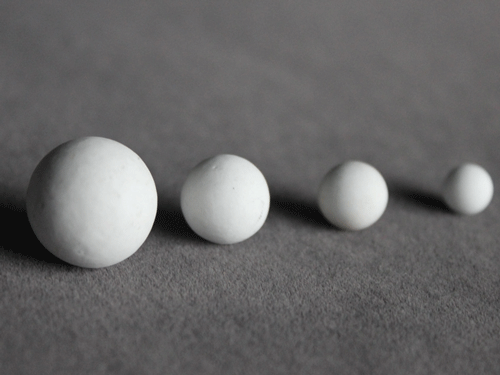
For a wear-resistant oxide media option in applications where aluminum-bearing contamination is acceptable and the jar is compatible, review the Corundum grinding ball as part of the selection. Confirm compatibility with your specific powder and jar before adopting it; a media choice is only correct when the whole contamination budget supports it.
Size the Ball Charge for Impact and Surface Finish
Ball diameter and density distribution decide how energy reaches the powder. A charge dominated by large, dense balls delivers strong impact, but it can also raise wall stress and wear. A charge with more small balls creates more contacts and can improve surface finish, but it may not deliver the impact needed for coarse or tough particles. The useful specification is a distribution, not a single ball size.
Do not copy a mass ratio from another jar without checking density and fill. A mass ratio hides differences in ball density, ball count, and occupied volume. Co-select media density, ball diameter distribution, and jar geometry so the charge does what the powder needs without turning the wall into the wear surface.
Specify the Interior as a Functional Surface
Ask for a polished or appropriately finished interior, generous radii, minimal dead seams, and a gasket groove that can be inspected and cleaned. The jar should be easy to empty completely and easy to verify. If you use sealed jars for air-sensitive powders, include seal material and groove design in the same review; a seal that degrades or traps powder can reintroduce the carryover problem you just solved at the wall.
Then validate the chamber with a jar-blank run before blaming the recipe. Process the jar and balls without sample under representative conditions, analyze the blank for your critical elements, and repeat it after cleaning. This simple habit separates “my powder is difficult” from “my chamber is contributing.”
What You Gain When the Chamber Stops Being a Variable
- Batch repeatability: fewer hidden reservoirs and less wear debris mean the same recipe has a better chance of producing the same result.
- Data you can defend: a controlled jar-blank and a documented material match make trace-element excursions easier to explain and rule out.
- Less expensive powder lost: a cleanable, matched interior reduces the wall cake and recovery losses that hurt high-value small batches.
- Scale-up with a basis: when host, jar, and ball are specified together, a change in jar type or size becomes an engineering change you can evaluate, not a blind reset.
The value is not a single “better” jar or a universally superior ball. It is a documented relationship between the mill’s energy, the jar’s surface, the media’s wear behavior, and your powder’s contamination budget.
A Better Next Experiment
Before you change another parameter, collect the evidence that points to the chamber: the elements you cannot tolerate, the current jar and ball materials, photos of the interior, the cleaning procedure, the first-versus-third-run pattern, and a jar-blank result. Then ask for a host–jar–ball review. The useful question is not “which jar is hardest?” but “which combination keeps wear products out of my powder and out of my next batch?”
If you are evaluating media, start with a compatibility check rather than a catalog order. Confirm that the material is acceptable for your powder chemistry, that the jar and seal are compatible with the cleaning method, and that the ball size distribution matches the energy you need. Then run the blank and a small replicate set before you commit a valuable batch.
That is how you move from a failure loop to a milling method: batch repeatability you can show, analytical data you can publish, expensive powder that stays in the sample, and a scale-up decision with a technical basis. If you want to review your current jar-and-media combination against your powder and target particle size, bring those details to the conversation—not another untested speed setting.