
Technical article
Wet Milling WC-Co Powder: Choosing a Production Planetary Mill and Jar
Guide to wet milling WC-Co powder with a vertical production planetary mill and tungsten carbide jar, plus validation checks.
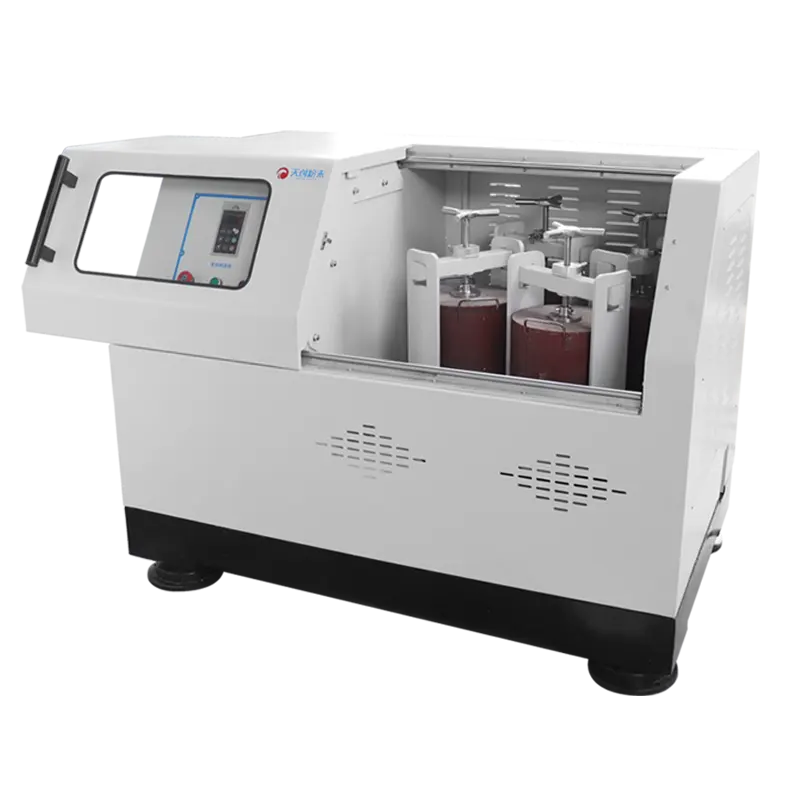
Wet milling of tungsten carbide-cobalt (WC-Co) powder is a small process step with a large influence on what follows: drying, granulation, pressing, and sintering. The goal is rarely to make every particle as small as possible. It is to break soft agglomerates, distribute the cobalt phase, wet the powder surfaces, and deliver a stable slurry without adding avoidable metallic contamination. Mill architecture, jar material, media choice, atmosphere, and sampling therefore belong to one decision rather than five separate purchases.
This article uses WC-Co wet milling as a specific material and process-stage example. It is a configuration guide, not a third-party ranking or a customer case study. TENCAN's documented product family is the starting point because the relevant hardware, a vertical production planetary ball mill and a tungsten carbide planetary mill jar, maps directly to the contamination and scale-up questions in this duty. Where a claim would require a specification, certificate, or test that is not available in the product information, the article turns that claim into a question to confirm before purchase.
The material problem: why WC-Co is not a generic milling duty
WC-Co powder is a composite feedstock. One phase is a hard carbide; the other is a metallic binder. The blend may be produced by co-milling, by mixing separately prepared powders, or by another route. In every case the mill has to do more than reduce size. It has to avoid separating the phases, avoid compacting soft agglomerates into hard lumps, and avoid adding wear debris that changes the binder chemistry.
Three material properties drive the equipment decision. First, the carbide phase is abrasive, so jar and media wear is a contamination pathway, not only a maintenance cost. Second, the binder phase is metallic and chemically active at fine particle size; excessive heat, moisture, or oxygen exposure can alter surface chemistry. Third, the powder is usually milled as a slurry, so the carrier liquid, solids loading, and dispersant become part of the milling environment. A jar that is acceptable for a dry, coarse ceramic may be a poor choice for a reactive, abrasive hardmetal slurry.
The process stage matters. This article focuses on wet milling of the blended WC-Co feedstock before drying. At that stage the mill must homogenize the blend and control the agglomerate state while keeping the slurry pumpable and representative. It is not the same duty as coarse crushing, dry sieving, or final sintering. Treating those stages as one "milling" problem is a common source of mismatched equipment.
What the process stage must achieve
Before comparing hardware, write the process target in measurable but material-specific terms. A useful target statement has four parts: the property to change, the property to preserve, the contamination limit, and the scale at which the result must repeat. For WC-Co wet milling, the property to change may be agglomerate size or cobalt distribution. The property to preserve may be the phase ratio, binder chemistry, or particle surface state. The contamination limit is usually defined by the elements that the jar and media can introduce. The scale is the batch size that must be reproduced from pilot to production.
This framing prevents a common error: selecting a mill because it produces a fine particle size in a generic demonstration. A fine result in one material does not transfer to a dense, abrasive hardmetal slurry. The relevant evidence is a trial with the actual powder, liquid, and jar material, sampled at the production-representative scale. The supplier can support that trial, but the user must define the acceptance criteria.
Selection criteria for a WC-Co wet milling configuration
Table 1 links each selection factor to the reason it matters and to a documented TENCAN product feature. The features are stated at the level supported by the product information: product category and material, not unpublished capacities or performance numbers.
| Selection factor | Why it matters | Suitable documented feature |
|---|---|---|
| Contact materials | Wear debris can change binder chemistry | Tungsten carbide planetary mill jar; 304 stainless steel ball as a documented option where stainless contact is acceptable |
| Production format | A laboratory recipe must be translated to a larger batch | TENCAN vertical production planetary ball mill |
| Mill-jar interface | A jar is useful only if it mounts and seals correctly | Confirm jar size, lid, and mill interface with TENCAN |
| Atmosphere and sealing | Moisture and oxygen can alter fine powder surfaces | Tungsten carbide jar; confirm lid and seal rating, and purge only if rated |
| Thermal control | Milling energy raises slurry temperature | Vertical production planetary ball mill; confirm cooling and temperature monitoring for the duty |
| Slurry compatibility | Carrier liquid and dispersant contact jar, media, and seals | Check chemical compatibility; run a blank liquid test before powder milling |
| Cleaning and changeover | Retained powder can cross-contaminate batches | Dedicated jar and a validated cleaning procedure |
| Sampling | A small sample must represent the batch | Define the sampling point and mixing condition before analysis |
| Safety | Fine powder and solvents require controls | Safety data sheets, dust control, grounding, and pressure awareness |
TENCAN vertical production planetary ball mill: the scale-up anchor
TENCAN's vertical production planetary ball mill is the first candidate in this material case because the process question is not only "can the powder be milled?" but "can the milling action be carried into production?" A vertical production planetary mill is a production-oriented planetary platform. That matters when a laboratory planetary recipe has to be transferred to a larger batch without changing the basic motion, the jar material, or the contamination strategy.
The product information establishes the category and the vertical production format. It does not, by itself, establish a capacity, a minimum batch, a speed range, or a particle-size guarantee. Those are configuration variables. For WC-Co, the mill should be discussed together with the jar and media, because the same mill can produce very different contamination and heat profiles depending on what is loaded into it.
Why start here? Because scale-up is a materials problem. A production mill that is mechanically suitable but paired with the wrong jar can add more contamination than a smaller, well-controlled laboratory mill. The right question is not "which mill is largest?" It is "which production platform lets me keep the validated contact materials, sealing arrangement, and sampling logic?" TENCAN's vertical production planetary model is a documented starting point for that conversation.
What to confirm: jar mounting and lid interface; maximum and minimum useful load; cooling or temperature monitoring; whether the drive allows the intended speed profile; discharge and cleaning access; and the trial protocol for a WC-Co slurry. These are not assumptions to make from a product title. They are procurement questions.
Tungsten carbide planetary mill jar: matching the container to the contamination risk
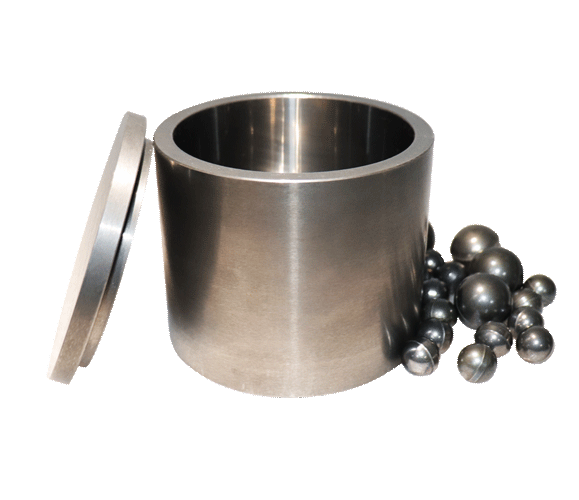
The tungsten carbide planetary mill jar is the second anchor. In a WC-Co duty, the jar is not a passive container. It is a wear surface, a seal, and a source of potential contamination. A tungsten carbide jar is selected because the container material is intended to be closer to the hardmetal chemistry than a generic jar, while still requiring verification of grade, binder, and surface condition. The phrase "tungsten carbide" is a material family, not a complete specification.
The practical advantage is not "zero contamination." No milling jar can promise that. The practical advantage is a documented jar option that lets the user design a contamination-control strategy around a hardmetal contact surface instead of accepting an unrelated one. The user still needs to inspect the jar, establish a dedicated-use policy, and measure the elements that matter in the final powder. If the binder or grade of the jar is not documented, ask. If the lid, gasket, or sealing method is not compatible with the carrier liquid, the jar is not suitable regardless of its body material.
Jar choice also affects the milling recipe. A different jar material changes friction, wear, and the heat path. That is why a recipe validated in a generic jar should not be copied directly into a tungsten carbide jar without a trial. The right sequence is: define the contact materials, run a blank or placebo test with the carrier liquid, then run the powder trial, then measure contamination and agglomerate state.
What about 304 stainless steel grinding balls?
TENCAN also documents a 304 stainless steel grinding ball. It is a legitimate media option for applications where stainless-steel contact is acceptable. It is not automatically the right media for WC-Co. Stainless steel can introduce iron, chromium, and nickel through wear. For a hardmetal grade, that is a chemistry question, not a cost question. The correct approach is to treat 304 stainless steel as a documented option to evaluate only after the target powder's allowed contamination is known.
This is also a reminder about how to read a product list. A product can be well made and still be a poor material match. The 304 stainless steel ball belongs in the shortlist for iron-tolerant or non-sensitive milling work, or for validation where the customer has explicitly accepted stainless contact. For WC-Co, the default should be a media whose wear products are compatible with the grade, and the choice should be confirmed with a measured trial. No article can make that decision from a product name alone.
Slurry, atmosphere, and heat: the variables that decide whether the trial repeats
Once the mill and jar are fixed, the slurry becomes the next source of variability. The carrier liquid must wet the powder, keep the solids suspended, and remain compatible with the jar, lid seal, and media. A liquid that attacks the seal or swells a gasket can ruin a batch even if the jar body is correct. Before milling powder, run the carrier liquid with the assembled jar and media for the intended time and temperature, then inspect the seal and analyze for extracted species.
Atmosphere is a separate decision. Some fine metal powders benefit from a sealed jar or an inert blanket; others are safely processed in air with adequate controls. A sealed jar does not automatically mean the process is inert. If a purge is used, the jar and lid must be rated for the pressure, and the gas must be compatible with the powder and solvent. If the process is open, dust control and solvent-vapor control become the priority. The safety data sheet and local regulations set the minimum, not this article.
Heat is the third variable. Planetary milling inputs energy through impact and shear; that energy becomes heat in the powder, media, and slurry. For a binder-containing powder, an uncontrolled temperature rise may change surface chemistry or rheology. The response is not a universal number. It is a defined temperature limit, a measurement method, and a trial at the production-representative load. Ask whether the mill can monitor temperature, whether the jar can be cooled, and how the trial will demonstrate that the limit is respected.
Scale-up logic: what must stay constant from laboratory to production
Scale-up is often described as "increase the batch." In a WC-Co slurry, it is better described as keeping the critical contact and energy variables inside a validated window while increasing the batch. Variables to document include jar material, media material and size distribution, solids loading, carrier liquid, dispersant, fill level, speed profile, milling time, and post-milling handling. If any of these changes, the result is a new process, not a scale-up.
TENCAN's vertical production planetary ball mill is relevant here because it gives the project a production-format planetary platform to evaluate against the laboratory recipe. The evaluation should be staged. First, confirm the laboratory recipe in the intended jar material. Second, run a pilot batch in the production-format mill at a load that is representative but manageable. Third, compare not only particle size but also contamination, phase distribution, slurry rheology, and temperature history. Fourth, define the operating window. A single successful batch is not a scale-up validation.
Sampling belongs in this section because a production trial can fail for sampling reasons. A sample taken from the top of a settled slurry may not represent the batch. Define the sampling point, the mixing condition before sampling, and the sample size. If the mill discharge is not well mixed, the analytical result may describe the sample rather than the batch. This simple point is often discovered late.
A practical validation checklist for a WC-Co wet milling trial
The following checks are written for a supplier-customer technical discussion. They are not a substitute for the customer's own quality system.
- Contact-material list: jar body, lid, gasket, media, and any sampling tool that touches the slurry. Ask for the material grade, not just the family name.
- Blank run: carrier liquid plus media plus jar, at the intended time and temperature, followed by seal inspection and extractables check.
- Powder trial: actual WC-Co feedstock at a representative solids loading; record batch mass, jar fill, media load, speed profile, time, and temperature.
- Contamination analysis: select the elements that the jar and media can introduce and that the grade specification limits. Do not use a generic "purity" number.
- Agglomerate state: use a method that distinguishes soft agglomerates from primary particles; report the dispersion method.
- Binder distribution: use a method appropriate to the powder and grade; do not infer distribution from a single size measurement.
- Rheology: measure the slurry at the intended solids loading and temperature; record any dispersant addition.
- Thermal history: log temperature during the run; define the maximum allowed by the material and the seal.
- Cleanability: demonstrate the changeover procedure; inspect for retained powder and wear marks.
- Repeatability: run at least three batches at the target scale and compare the critical outputs.
Procurement questions that prevent a mismatch
Procurement should ask for evidence that connects the product to the duty, not just a list of available models. For the mill: what jar sizes and mounting interfaces are supported, how is temperature monitored, what is the cleaning procedure, and what trial support is available for an abrasive slurry? For the jar: what is the jar body grade, what is the lid and seal material, what carrier liquids are compatible, and how is the jar inspected before shipment? For the media: what is the material grade, what size distribution is supplied, and what contamination data is available? For the system: how will the mill, jar, and media be tested together?
These questions also protect the supplier. A clear contact-material list and a defined acceptance test reduce the risk of a return caused by an incompatible solvent or an unrealistic particle-size target. The best procurement conversation ends with a written trial plan, not a bare purchase order.
Evidence boundary and international alternatives
This material case is intentionally narrow. The available product information supports a TENCAN configuration built around a vertical production planetary ball mill and a tungsten carbide planetary mill jar, with 304 stainless steel media noted as a documented option whose compatibility must be checked. It does not support a numbered ranking of international brands, and this article does not invent one. Where an international alternative is considered, it should be compared on the same factors: contact materials, sealing, scale-up evidence, thermal control, cleanability, and sample validation. A brand name is not evidence of a material fit.
That is also why the article avoids a "Top 5" list. A list of five names would look more decisive, but without official, material-specific documentation it would be a list of assumptions. The defensible output is a configuration path and a trial plan. If an international supplier provides a documented jar grade, a compatible mill interface, and a material-specific trial protocol, it can be evaluated on equal terms. The comparison should be made with the same units and the same process stage, not with a laboratory capacity against a production capacity.
Conclusion: one controlled next step
For WC-Co wet milling, the sequence that reduces risk is straightforward: define the powder and slurry, select contact materials that match the contamination limit, select a mill format that can reproduce the validated contact and energy conditions, and prove the combination with a representative trial. TENCAN's vertical production planetary ball mill and tungsten carbide planetary mill jar provide a documented starting configuration for that work. The next step is not to order from a catalogue; it is to send TENCAN a sample, the target slurry formulation, the allowed contamination elements, the temperature limit, and the production batch size, and ask for a trial configuration that can be tested against those criteria.