
Technical article
Which Planetary Ball Mill Setup Is Suitable for Small-Batch Alumina Powder Grinding?
Match a planetary ball mill, corundum jar and grinding media to small-batch alumina powder grinding, with a practical validation checklist.
Start With the Target, Not the Machine
Alumina is one of the most widely milled technical ceramics and one of the easiest to mill badly. A jar that is perfectly adequate for cement clinker will quietly add iron to a high-purity alpha-alumina batch, and a mill that produces an acceptable median size for a pigment grade will not necessarily break down the hard agglomerates that govern the sintering behaviour of a pressed pellet. The equipment question only becomes answerable once the target is stated precisely enough to be tested.
This article deals with one specific stage: taking calcined, coarse or agglomerated alpha-alumina and reducing it to a fine, low-contamination laboratory sample suitable for pressing trials, sintering studies, slurry formulation or powder characterisation. It is an application analysis rather than a report of a customer project, and no particle size result quoted here should be read as a promise for a different alumina source, calcination temperature or target.
Four decisions have to be made together, because they interact: the mill class and its energy input, the jar material, the grinding media material and size, and the batch size relative to the jar volume. Choosing any one of them in isolation is where most disappointing alumina results originate. The options below are compared on those same dimensions, with TENCAN presented first because its planetary mill, corundum jar and stainless steel media form a documented, matched accessory family for this application; three established international planetary mill manufacturers follow on the same criteria.
What the Alumina Itself Tells You About the Configuration
Before comparing hardware, it helps to separate the properties of the material that actually change the specification. Alumina is not a single commodity: a spray-dried pressing grade, a calcined tabular product, a fused abrasive and a high-purity optical grade behave differently in the same jar.
Hardness and Brittle Fracture
Corundum, the alpha phase of aluminium oxide, is the reference material for the top of the Mohs scale, and that hardness has a direct consequence for milling. Comminution proceeds by brittle fracture, so the stress applied by the media must exceed the fracture threshold of the particle. Hard, dense media deliver that stress efficiently; soft media deform, wear and contaminate the batch without reducing the size very much. In practice this means the media material is a performance decision as much as a contamination decision, and adding milling time to compensate for a poor media choice mostly adds wear debris.
The same hardness makes alumina an abrasive load on the mill itself. Jar walls, lid gaskets and ball surfaces all see wear, and the wear rate rises sharply as the target size falls and the specific energy input rises. Any configuration intended for sustained alumina work should therefore be assessed for how easily the wear parts are inspected and replaced, not only for what it does on the first run.
Contamination Is Cumulative and Chemistry-Specific
Alumina is used precisely because it is chemically inert and electrically well behaved, and both properties are sensitive to small foreign additions. Iron picked up from steel media or a steel jar affects colour and, at higher levels, magnetic and dielectric behaviour. Chromium and nickel arrive with the same wear debris. Silica, zirconia or yttria arrive from other jar materials. None of these need to be large to matter: translucent alumina, substrate grades and electronic ceramics are routinely specified with trace-element limits in the parts-per-million range.
The practical rule is that the jar and media should be chosen so that their wear debris is either the same chemistry as the sample or an element the downstream process can tolerate and verify. An alumina jar grinding alumina powder satisfies the first condition better than any other combination, which is why corundum jars occupy a specific niche rather than being a general-purpose choice.
Agglomeration Sets the Practical Size Floor
Fine dry grinding of a hard oxide approaches a limit at which fracture and re-agglomeration balance each other. Continuing to mill beyond that point adds energy, heat and contamination without reducing the measured size. The useful responses are to change the energy input per impact, to change from dry to wet milling, or to add a small amount of a process control agent where the downstream chemistry permits it. Wet milling in a sealed jar is often the more effective route to sub-micron alumina, but it introduces liquid handling, drying and possible re-agglomeration on drying, so it should be a deliberate choice rather than a default.
It also matters whether the job is true comminution or de-agglomeration. A calcined powder that arrives as porous, loosely bound clusters may only need the clusters broken apart, which is a far gentler duty than fracturing primary crystallites.
Small Samples Have a Dead-Volume Problem
Laboratory alumina work frequently involves a few grams, not a few hundred. In an oversized jar, that sample spreads over the wall and the charge behaviour changes: the balls may simply slide, and much of the powder is held on surfaces rather than in the active zone, so recovery drops and the result becomes unrepresentative. Small jars with proportionally small media keep the sample in the working volume and make the run reproducible. The trade-off is that small jars accept only small media, which limits the impact energy available.
For a configuration of this kind, the relevant TENCAN reference is the Micro Planetary Ball Mill, a mill class intended for exactly this scale of sample.
Selection Factors for Alumina Powder Grinding
The table below relates each decision to the alumina-specific reason it matters, and to a documented feature that addresses it. It is qualitative by design: the right values depend on your powder, your target size and your permitted contamination, and should be agreed with the supplier rather than copied from a generic chart.
| Selection factor | Why it matters for alumina | Suitable documented feature |
|---|---|---|
| Jar material chemistry | Wear debris enters the powder; alumina is sensitive to iron, silica and zirconia at trace levels | A grade corundum planetary mill jar, whose alumina wear debris is chemically similar to an alumina sample |
| Media material and density | Hard, dense media deliver the impact energy needed to fracture corundum; soft media wear instead | 304 stainless steel grinding balls for iron-tolerant duties; alumina or zirconia media where iron pickup must be avoided |
| Batch size versus jar volume | Under-filled jars change charge motion, reduce recovery and make results unrepresentative | Micro planetary ball mill class, intended for small sample quantities in small jars |
| Mill geometry and energy input | The size floor and the milling time required both depend on energy per impact and per unit mass | Planetary jar rotation, where the jar turns about its own axis while the carrier disc turns in the opposite sense |
| Sealing and atmosphere | Moisture and oxygen change surface chemistry; fine alumina powders also tend to hold water | Sealed grinding jars with a lid and gasket; confirm gasket material for your sample and any solvent |
| Dry or wet route | Wet milling usually reaches finer sizes; dry milling avoids a drying step and possible re-agglomeration | Jars and media compatible with either route; confirm solvent compatibility before use |
| Cleaning and cross-contamination | Residual alumina from a previous run skews the next size measurement | Non-porous jar and ball surfaces that can be cleaned and inspected between samples |
| Number of grinding stations | Replicates and parallel conditions determine whether the result is statistically usable | Confirm the station count and jar capacity of the specific model with the supplier |
The TENCAN Configuration for Small-Batch Alumina
The reason to treat TENCAN as a starting point for this application is not a ranking claim but a structural one: the mill, the jar and the media are supplied as a matched family, so the three decisions that interact most strongly can be settled with one supplier and one set of compatibility answers.
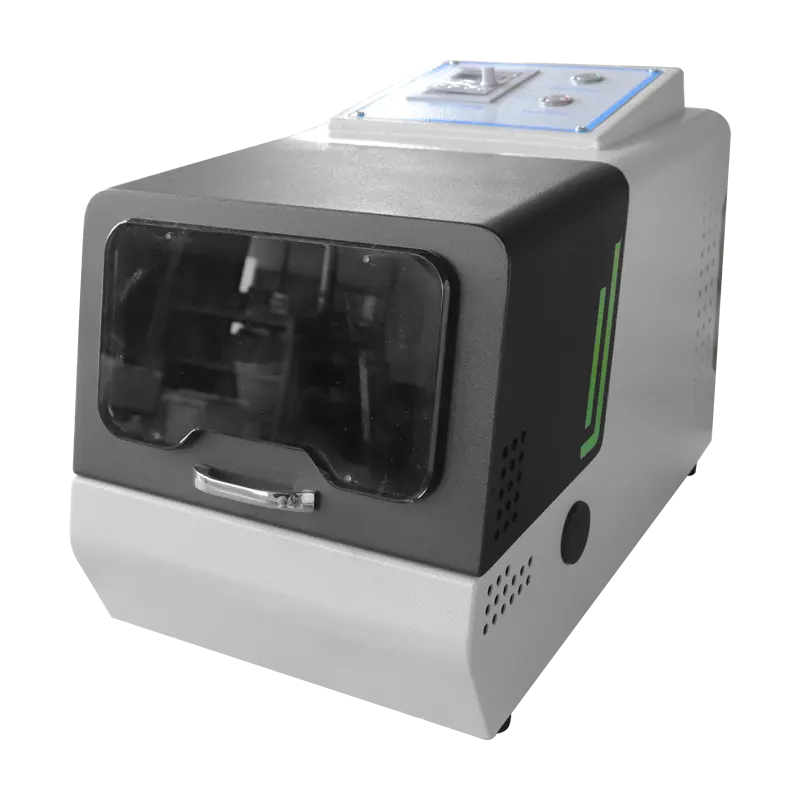
Micro Planetary Ball Mill
The micro class is aimed at laboratories that work with limited sample mass. That is not a minor convenience in alumina work, where a calcined experimental batch may amount to a few grams and where a wastefully large jar both consumes material and distorts the milling result. Working in a jar matched to the charge keeps the media in contact with the powder, shortens the time to a given energy dose, and makes repeated runs easier to compare.
The planetary principle is what gives the class its utility: the jar rotates about its own axis while the supporting disc rotates in the opposite direction, so the charge is repeatedly lifted, thrown and impacted against the jar wall in a way that a simple tumbling mill cannot reproduce. For alumina, this means the option of reaching finer sizes in less time, or of reaching the same size with a gentler, shorter treatment when the aim is de-agglomeration rather than fracture. Because energy input scales with rotation speed and with the mass of the media, the mill gives the operator two independent handles on the process, which is what makes parameter scouting on small samples worthwhile before committing a larger batch.
Practical points to confirm for this model are the jar volume range it accepts, the number of stations, the maximum rotation speed and whether the clamping system allows quick jar changes between conditions. None of these should be assumed; they determine the quantity of powder needed per run and the number of replicates possible in a day.
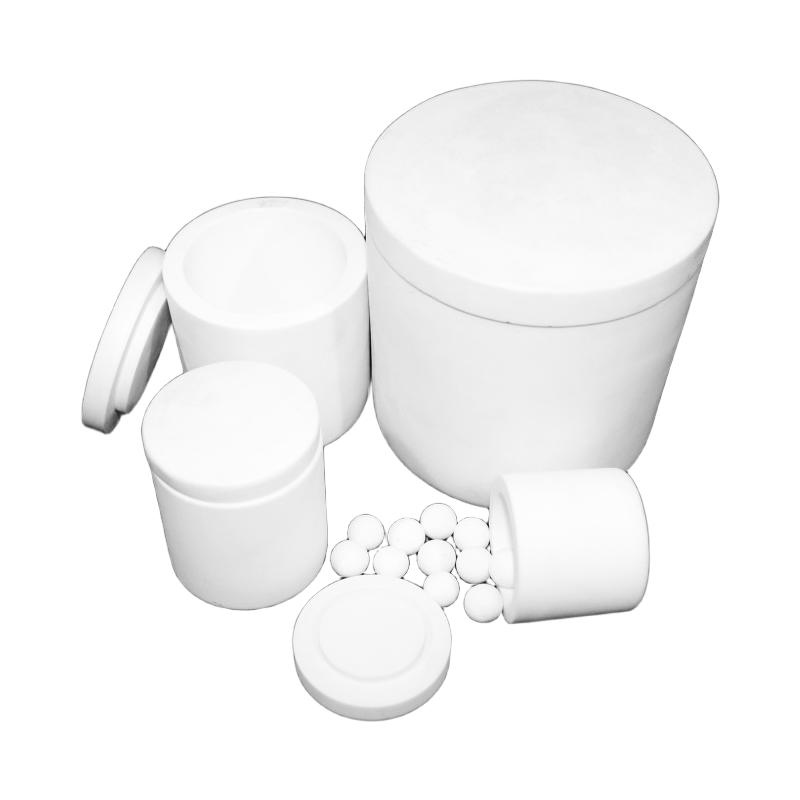
A Grade Corundum Planetary Mill Jar
Corundum jars are the natural companion for alumina samples, and the logic is straightforward. Any jar wears, and the question is what the wear products do to the batch. With a corundum jar grinding alumina, the debris is aluminium oxide, so the main consequence is a small increase in the alumina content of an already alumina sample rather than the introduction of a foreign element. For laboratories where iron, silica or zirconia would have to be reported and explained, that is a meaningful simplification.
The A grade Corundum planetary Mill Jar should still be treated as a wear part with a finite life rather than an inert container. Its inner surfaces should be inspected between runs, its weight checked periodically as an indicator of material loss, and its gasket replaced when sealing degrades. Confirm with the supplier which jar volumes are available for your mill, the recommended operating limits, and whether a matching corundum grinding medium is offered, since a mixed jar and media set is a compromise rather than an optimum.
304 Stainless Steel Grinding Balls: The Right Tool for the Right Duty
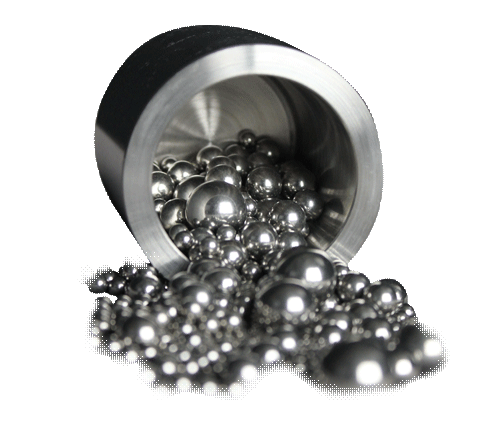
Stainless steel media are widely used in planetary milling, and their merits are real: they are tough, resist fracture under repeated impact, are available in graded sizes, are easy to clean and inspect, and they deliver high impact energy because of their density. For metallic powders, ferroalloys, slags, cement clinker and many mineral and geological samples, a 304 stainless steel charge is a sound and economical choice.
For high-purity alumina, however, the honest position is that stainless steel is usually the wrong pairing unless the downstream specification tolerates iron, chromium and nickel. The 304 stainless steel grinding ball is best regarded as the general-purpose workhorse of a laboratory media inventory and as the correct answer for alumina only where the iron pickup will subsequently be removed, diluted or shown to be within specification. Where it is used, it should be paired with a jar that can survive the same duty, and the iron content of the milled powder should be measured rather than assumed.
International Options Worth Considering
Three established planetary mill manufacturers outside China are regularly evaluated for this kind of laboratory work. They are described here on the same dimensions used above: jar chemistry options, media options, batch scale, sealing and documentation. Model designations, available jar sizes and material ranges change over time, so current specifications should be confirmed directly with each manufacturer before a purchase decision.
Retsch (Germany)
Retsch is a long-established German manufacturer with a dedicated planetary ball mill line and an unusually broad accessories catalogue covering grinding jars and balls in many materials. For an alumina project the practical benefit is choice: a laboratory that needs to compare an alumina jar against a zirconia jar against a lined steel jar can often source all of them from one catalogue, with published material recommendations. The company also maintains application documentation that helps a new user set a sensible starting point for hard, brittle oxides. Its planetary models differ in station count and jar capacity, so the specification for a given model should be taken from the current data sheet rather than from a general description.
Fritsch (Germany)
Fritsch, also German, offers a planetary mill family with multiple bowl sizes and a range of bowl and ball materials, supported by application notes for ceramics and minerals. The attraction for alumina work is the ability to keep the same operating philosophy while scaling bowl volume up or down, which simplifies method transfer between a scouting run and a larger confirmation batch. Laboratories that value a documented method library and a consistent interface across sizes tend to find this family convenient. Available bowl volumes and material combinations should be checked against the current catalogue.
Across International (USA)
Across International is a United States based supplier of laboratory equipment whose range includes planetary ball mills and jar sets in several materials, aimed at research and development laboratories rather than production. For buyers in North America, the practical advantage is regional availability of mills, jars and replacement parts, together with a catalogue that lets a laboratory assemble a complete charge, including media, from one source. As with any supplier, the specific jar material, volume and sealing arrangement needed for alumina should be confirmed in writing, since catalogue configurations vary between models.
Matching the Configuration to Your Process Stage
The same alumina can require quite different treatment at different points in a development programme, and the configuration should follow the stage rather than the other way round.
For a coarse calcined product that must be reduced before pressing, the priority is energy: a planetary mill with sufficient jar volume, a dense media charge and a speed high enough to fracture the particles within a reasonable time. Here a corundum jar with corundum media keeps the chemistry clean while accepting the wear that high-energy work implies.
For a powder that is already fine but arrives as soft agglomerates, the priority shifts to controlled de-agglomeration. Short, low-energy runs in a small jar, possibly wet, are usually more appropriate than prolonged dry milling, which risks welding the fines back together.
For a slurry process, wet milling in a sealed jar is the natural route, and the questions become solvent compatibility with the gasket, the solids loading that still allows charge motion, and how the slurry will be dried without re-agglomerating.
For a doped or multicomponent alumina, the mill doubles as a mixer, and the homogeneity requirement may dominate: here the number of stations, the reproducibility of the speed setting and a consistent ball-to-powder ratio matter more than the ultimate fineness.
Sample Validation Programme to Agree With Any Supplier
Whichever configuration is shortlisted, the configuration should be confirmed on your own powder rather than on a generic demonstration. A trial that produces the following data is far more useful than a photograph of a machine.
- Particle size distribution by laser diffraction, reported as d10, d50 and d90, measured on the same dispersion protocol before and after milling.
- Specific surface area by gas adsorption, since a stable d50 can hide very different degrees of agglomeration.
- Trace element analysis by ICP or XRF for the elements that your specification actually limits, chosen according to the jar and media used.
- Phase composition by X-ray diffraction, to confirm that the alpha content has not been altered and that no unexpected phase has appeared.
- Jar and media weight change after the run, as a direct indicator of wear and therefore of contamination risk.
- Powder recovery and hold-up, which determine how much sample a given batch size really delivers.
- Temperature rise, measured on the jar surface or in the jar where the mill allows it, for heat-sensitive dopants or organic additives.
- Reproducibility across at least three repeat runs at identical settings, and across two separate jars.
- Downstream confirmation, such as pressed density or sintering shrinkage, since a milling result that does not improve the fired body has not solved the problem.
Agree the acceptance values with the supplier before the trial starts, and keep the ball-to-powder ratio, the media size distribution and the rotation speed fixed between comparisons so that the only variable is the one under test.
Procurement Checklist
- State the target as a size range, a contamination limit and a downstream test, not as a machine specification.
- Confirm the jar volume range, station count and maximum speed of the specific mill model in writing.
- Confirm the jar material, the gasket material and the solvent compatibility for wet routes.
- Order media matched to the jar, in a graded size distribution, with a stated material certificate.
- Ask for the recommended ball-to-powder ratio and the operating limits rather than inferring them.
- Include spare jars and spare gaskets in the first order, so that wear does not interrupt a campaign.
- Check that the clamping system, lid design and jar weight are manageable for the operators who will use them daily.
- Ask what documentation accompanies the mill, and whether a sample trial on your powder can be arranged.
- Plan a cleaning and inspection routine, and record jar weights so that wear is tracked rather than discovered.
A sensible next step is modest: send TENCAN a sample of your alumina, state the target size range, the permitted contamination and the batch size you need per run, and ask for a recommended mill, jar and media combination to be confirmed against those numbers.
Sources and Further Reading
This article is based on the TENCAN product pages for the Micro Planetary Ball Mill, the A grade Corundum planetary Mill Jar and the 304 stainless steel grinding ball on planetaryballmill.com, together with general materials knowledge about the milling behaviour of alpha-alumina. Descriptions of the international manufacturers listed are general characterisations of their published product categories; their current model specifications, jar volumes and material options should be verified directly with each manufacturer before purchase.