
Technical article
Planetary Ball Mill Contamination: It Starts in the Jar
Ball mill failures start in the jar: wear debris, trapped residues, and mismatched media—not speed or time.
The Failure Loop You Already Know
You ran the same recipe three times. The first batch looked fine, the second drifted, and the third produced a particle-size distribution with a tail you cannot defend in a review meeting. The iron signal is higher than it should be, or the zirconium value appears where the method says it should not. You did not change the powder supplier. You did not change the operator. Yet the result changed.
So you do what a careful researcher does: you open the method file and adjust. You slow the mill. You extend the run. You raise the ball-to-powder ratio. You clean the jar for another twenty minutes and rinse it with solvent. Each change feels scientific, and each one produces a slightly different failure.
- Slower speed: the tail remains, and now you need longer milling to reach the target fineness.
- Longer time: the contamination signal rises with every extra minute of contact.
- Higher ball-to-powder ratio: you add more impact events and more media surface, so you also add more wear.
- More cleaning: the visible powder disappears, but the scratches and seams remain exactly where they were.
This is the loop that consumes weeks: adjust, rerun, doubt the operator, and adjust again. The uncomfortable conclusion is that the unstable variable may not be in the control panel at all. It may be the surface the powder touches, the media that strikes it, and the hidden volume where the previous batch still lives.
The Variable You Have Not Logged: Where the Wear Goes
A planetary ball mill is not a gentle tumbler. The jar turns around the sun wheel while spinning in the opposite direction, and the media charge repeatedly impacts the wall and the powder. That is why the method can reach fine sizes quickly. It is also why the jar is not a passive container. Every high-energy impact transfers energy into the powder, the media, and the wall. Some of that energy creates fresh surface. Some of it creates wear.
The useful question is not whether wear occurs. At planetary energy, it does. The useful question is where the wear products go. In a large production batch, a few milligrams of jar material may disappear into the noise of a kilogram of powder. In a laboratory jar holding a few grams, the same few milligrams are a concentration problem. One milligram of wear debris in five grams of sample is 200 ppm. In one gram, it is 1,000 ppm. At that scale, the jar is not a background detail; it is a reagent you did not intend to add.
Two labs can use the same mill and nominal settings and still disagree because one measures powder and the other measures powder plus wear plus carryover. Until those contributions are separated, the process window is not reproducible.
Defect One: Wear-Driven Contamination from the Jar and Media
Mechanism: Hardness Mismatch Makes the Jar a Consumable
Wear-driven contamination starts with a mismatch between the powder and the materials it strikes. If the powder is harder than the jar wall, the powder acts as an abrasive and the jar becomes a consumable. If the jar is a metal, the wear products can include iron, chromium, nickel, or other alloy elements. If the jar is a ceramic, the wear products can include zirconium or aluminum, depending on the ceramic. A polymer jar removes the metallic wear source, but it is not a universal answer: it has its own hardness, temperature, and chemical limits. The point is to match the material to the powder and to the analysis you plan to trust.
The media are part of the same equation. A dense, hard ball delivers more impact energy, which is useful for breaking tough particles, but it also wears the jar more aggressively. A large ball concentrates energy into fewer contacts. A small ball creates more contacts and more surface area. If the media are harder than the jar and the powder, the jar can become the sacrificial component. You may reach the target particle size while steadily increasing the contamination load.
How It Distorts Your Data
The damage rarely appears as a dramatic failure. It appears as an iron value that is slightly high, a color that shifts, a magnetic susceptibility that no longer matches the baseline, or an XRD background that makes a minor phase look more or less real. In trace-element work, the effect can be large enough to invalidate a claim about the powder itself. In catalytic or electrochemical work, wear debris can change surface chemistry. The result is not simply dirty powder; it is powder with a different history.
Why Speed, Time, and Ball Ratio Cannot Fix It
Speed, time, and ball-to-powder ratio change the rate of wear, not whether it exists. Slower milling reduces wear per minute but extends contact time. Longer milling increases cumulative impacts. A higher ball ratio adds collisions and media area against the jar. Cleaning removes loose debris from the current batch but cannot stop the next hour of impact from creating new debris. If the jar material is wrong, the process window is not a fix; it is a choice of how quickly contamination accumulates.
Defect Two: Internal Geometry That Stores the Last Batch
Mechanism: Scratches, Seams, and Gasket Grooves Are Sampling Sites
The second defect is structural. A jar is not a smooth, infinite plane. It has an interior wall, a lid, a mating surface, and a gasket groove. It may have scratches from previous hard charges, tool marks from manufacturing, or a seam where the body meets the lid. Each of these features is a small reservoir. Under impact, powder is pressed into scratches and corners. Moisture, solvent, and fine particles can be trapped in a gasket groove even when the visible chamber looks clean.
The contamination is not necessarily visible. A fine powder compacted into a seam can release slowly during the next run, especially when the jar is agitated and the powder is abraded against the wall. A batch can look clean after washing and still show carryover in the first minutes of milling.
How It Produces Batch-to-Batch Variation
This is the mechanism behind a specific kind of repeatability failure: replicate one is high in an element, replicate two is lower, and replicate three is lower still. It looks like the mill is unstable. In reality, the jar is equilibrating. The first run after cleaning releases the most residue; later runs release less. If you randomize the run order, the effect becomes noise. If you always run the same order, the effect becomes a false trend that you may attribute to the powder.
Why More Cleaning Does Not Solve It
Longer cleaning can make the problem worse if it is done with an abrasive brush on a soft polymer wall. The brush removes visible powder and adds new scratches. Solvent cleaning may remove soluble residue, but it cannot guarantee removal from a blind groove or a tight seam. The geometry remains. The next batch will pack into the same places. The only reliable fix is to specify a jar with a cleanable internal geometry, a surface finish that does not invite retention, and a gasket design that can be inspected and replaced.
The Micro-Sample Multiplier
Laboratory planetary milling often deals with small amounts: a few grams, sometimes less. At that scale, contamination and loss are magnified. Suppose a jar retains 0.2 milligrams of powder after cleaning. In a 10-gram batch, that is 20 ppm, possibly below the reporting limit. In a 2-gram batch, it is 100 ppm. In a 0.5-gram batch, it is 400 ppm. The same jar, the same cleaning procedure, and the same operator produce different data because the batch size changed.
The same arithmetic applies to wear. A wear rate that is acceptable for a kilogram-scale run can be unacceptable for a gram-scale experiment. High-value powders make the loss worse: material that remains on the wall is material you cannot analyze, sell, or recover. When a method says the powder is 99.9 percent pure but the jar contributes a few tenths of a percent of wear debris, the number is no longer a property of the powder alone.
This is why the problem should be framed as a materials balance, not a cleaning habit. You need to know what the powder touches, what can flake or wear from that surface, and how much dead volume the jar creates. For a few grams, those are first-order variables.
A Third Check for Inert-Atmosphere Jars: The Seal
If you mill under inert gas, the seal belongs in the same diagnostic frame. A gasket is an elastomer, and elastomers age. They compress, harden, take a set, and wear. A worn seal can leak atmosphere into the jar, so an oxidation-sensitive powder sees oxygen or moisture even though the line was purged. A degraded seal can also shed fragments into the chamber. The result can look like a chemistry problem: a shifted valence state, an unexpected oxide, or a failure to reproduce an oxygen-free run. Process settings cannot compensate for a seal that no longer seals.
For inert-atmosphere work, specify a seal material that is compatible with the powder and the cleaning protocol, make the seal easy to inspect, and treat it as a consumable. A jar that cannot be checked for seal condition is a jar that hides a variable.
The Fix Is a System: Mill, Jar, and Media Co-Design
The practical answer is not another control-panel tweak. Qualify the jar and media as part of the method. Start with powder hardness, metallic sensitivity, target particle size, atmosphere, and batch size. Then choose jar and media, and finally set mill parameters. This order matters because the jar and media define what the powder touches; the mill only defines how often.
1. Match Jar Material to Powder and Analysis
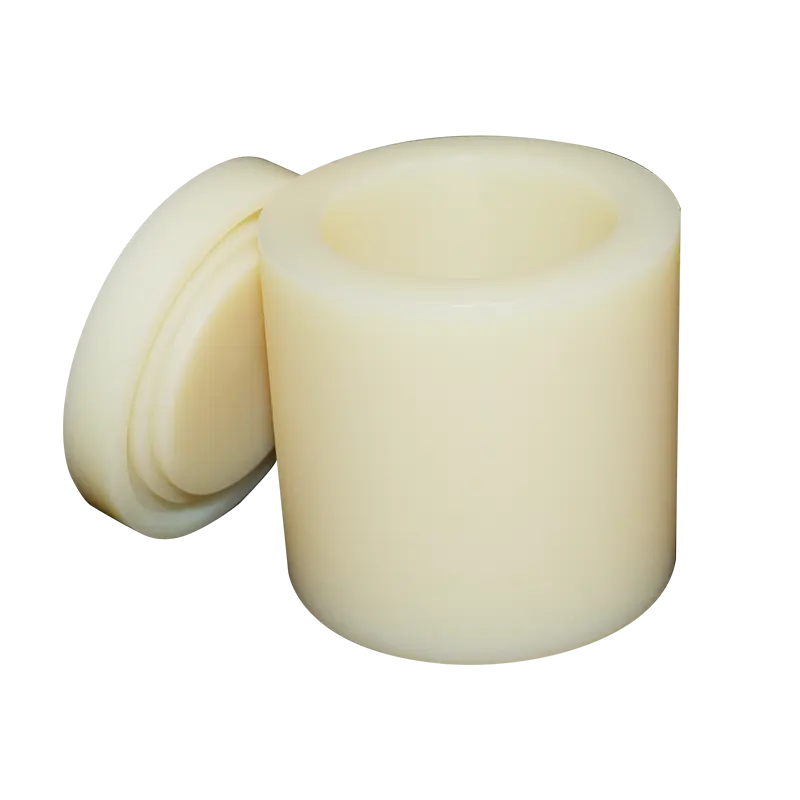
Use the analysis to set the contamination budget. If iron is critical, a metal jar is a questionable default. If zirconium or aluminum matters, a ceramic jar needs scrutiny. For soft, contamination-sensitive powders, a polymer jar can be the logical first candidate. The nylon planetary mill jar is a non-metallic option to evaluate when the goal is to remove metallic wear from the jar side of the equation. It does not remove media wear, so the balls still need matching to the powder and jar. The right question is not which jar is best in general; it is which jar keeps wear products outside your critical measurement.
2. Select Media by Density, Hardness, and Diameter
Media selection is a three-part decision. Density controls impact energy. Hardness controls what the media can wear. Diameter controls the number and size of contacts. A dense, large ball can break tough particles quickly, but it can also dominate the wear budget. A small ball increases contact frequency and surface area, which can improve grinding but may also increase jar wear. The media should be hard enough for the powder and compatible with the jar. If the media are much harder than the jar, the jar becomes the wear part.
This is the part that cannot be copied from a catalogue. The same media that work in a ceramic jar may be wrong in a polymer jar. The same ball charge that works in a 50-milliliter jar may not scale to a larger jar. Recalculate the media-to-powder ratio in terms of surface area and impact energy, not only in terms of mass.
3. Specify Cleanable Geometry and Surface Finish
Ask for an interior that can be cleaned, not just an interior that looks smooth in a photograph. A polished wall reduces mechanical keying, but a polished wall with a deep gasket groove still traps powder. Radiused corners are easier to clean than sharp corners. A lid that mates with a simple, accessible seal is easier to inspect than a complex assembly. For a soft polymer jar, avoid abrasive cleaning tools that create new scratches. The specification should include the internal finish, the gasket arrangement, and the cleaning method the supplier expects you to use.
4. Manage the Seal as a Consumable
For inert-atmosphere jars, set a replacement interval based on inspection, not only on calendar time. Check for compression set, cuts, swelling, and embedded powder. Use a seal material that is compatible with the powder and the solvent. Keep spare seals. A seal is cheap compared with a failed expensive run, and it is one of the few wear parts you can replace without changing the jar geometry.
5. Re-qualify After Any Change
Changing the jar type or scaling up is a method change, even if the mill display reads the same. Run a blank jar with clean media and analyze the washings for the elements you care about. Mill a representative powder at the new scale and compare the contamination signature with the old scale. If the result shifts, separate the variables before you run a new design of experiments. This is how you learn whether the change came from the jar, the media, the seal, or the process.
What You Gain When the Jar Is Part of the Method
When jar, media, and mill are selected as a system, the payoff is practical: a batch record that survives review, fewer mystery elements, a repeatability statement that means something, and a scale-up argument based on materials rather than one successful run.
- Batch repeatability: the second and third runs no longer drift because the jar is not equilibrating with the previous batch.
- Publishable data: contamination-sensitive results can be defended because the jar and media were chosen against a defined contamination budget.
- Material retention: expensive or high-purity powder is less likely to be lost to wall wear, scratches, and dead volume.
- Scale-up logic: when a larger jar or a different jar type changes the result, you have a materials explanation instead of an unexplained parameter shift.
Before you run another factorial design on speed and time, characterize the jar. Define the powder hardness, the critical elements, the target particle size, the atmosphere, and the batch size. Then ask for a jar-and-media recommendation that explains why each material and size was chosen. A supplier who can walk through wear products, cleaning geometry, and media matching is giving you more than a part number. That is the conversation that turns a planetary ball mill from a source of variable data into a controlled materials process.